Hear from Our Customers
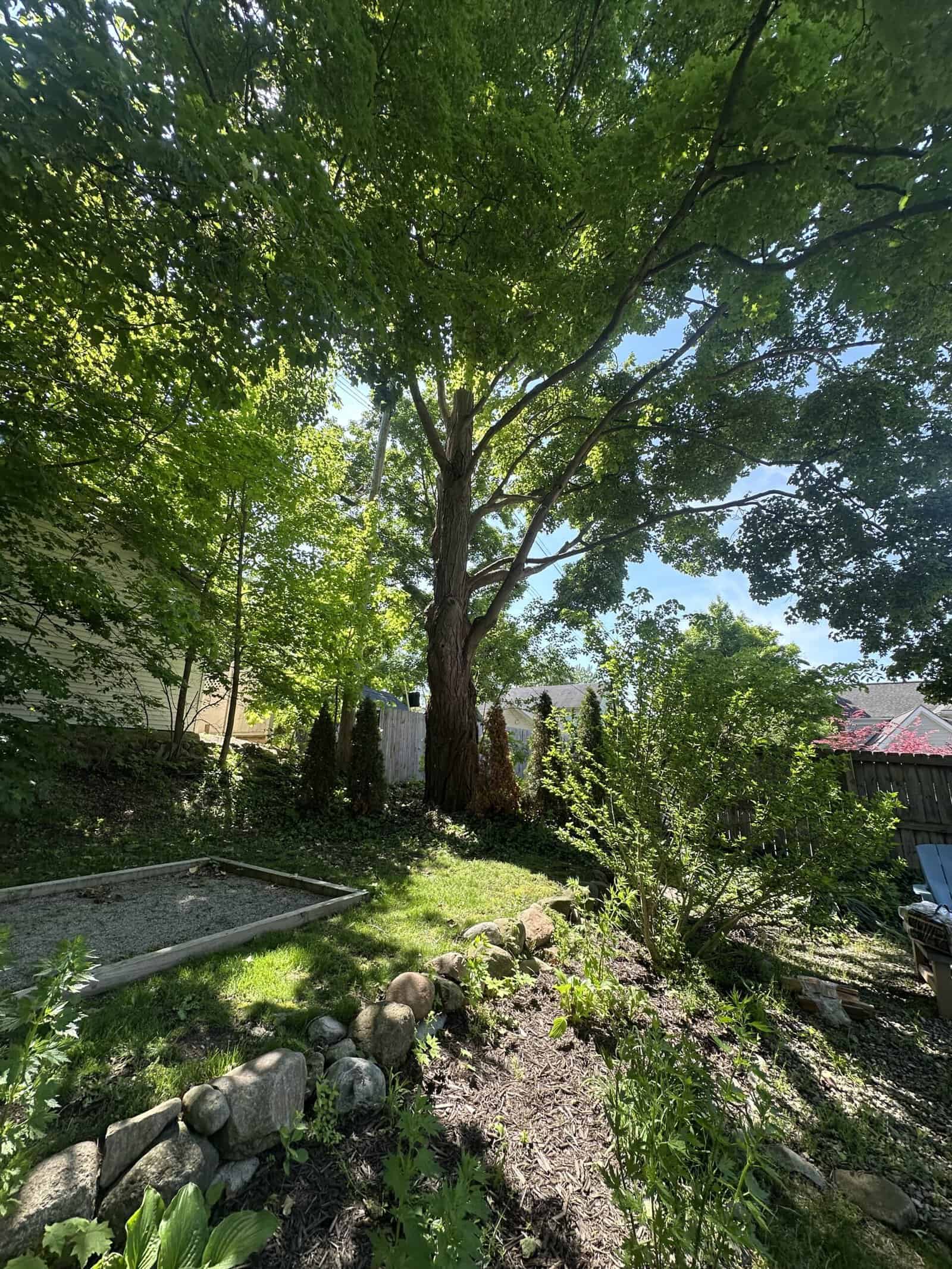
Most of Livonia’s residential neighborhoods — from SMB Estates to Old Rosedale Gardens — were developed in the 1950s and 1960s. The trees that went in the ground back then are now massive, structurally complex, and carrying decades of accumulated canopy weight. When those trees are professionally pruned, the difference is immediate and practical. The canopy opens up, light reaches the yard again, and you’re no longer looking at a wall of dense overgrowth pressing toward your roofline.
But there’s a more important outcome than aesthetics. After the June 2024 EF-1 tornado cut a 5.5-mile path through Livonia’s residential streets — snapping major limbs, uprooting large trees, and causing a fatality near the Five Mile Road corridor — a lot of homeowners started asking the right question: not what fell, but what’s still standing that shouldn’t be. Crown thinning reduces the wind resistance in a dense canopy. Structural pruning removes the co-dominant stems and over-extended branches that become projectiles in a high-wind event.
Well-maintained trees also protect and grow your property’s value. Research consistently shows mature trees add 7 to 19 percent to home value — in Livonia’s appreciating housing market, that can translate to $10,000 or more. The trees on your property are part of that equation.
We’ve been delivering tree care across Southeast Michigan for over seven years. We’re family-owned and operated — I lead every field job personally, and Cecilia manages scheduling and customer communication so you’re never left chasing a callback or waiting on a vague estimate window. That kind of direct accountability is harder to find than it sounds.
On every large residential job in Livonia, we field ISA Certified Arborists and TRAQ-qualified risk assessors — the people who can actually evaluate whether a mature oak near your home in Burton Hollow poses a structural risk, not just whether it looks overgrown. For trees growing near Livonia’s overhead utility corridors, we also hold line-clearance certification with the specialized training and utility-specific insurance that work near energized power lines requires.
Every job starts with a written estimate and a site walk. No surprises on the invoice, no scope creep, no showing up and deciding what the job is after the fact. That’s the standard — not the exception.
It starts with a call or a booking request. Cecilia handles scheduling and will get you on the calendar without the runaround. Before any work begins, we walk your property with you, assess the trees in question, and put together a written scope of work. You know exactly what’s being done, where, and why — before anyone picks up a tool.
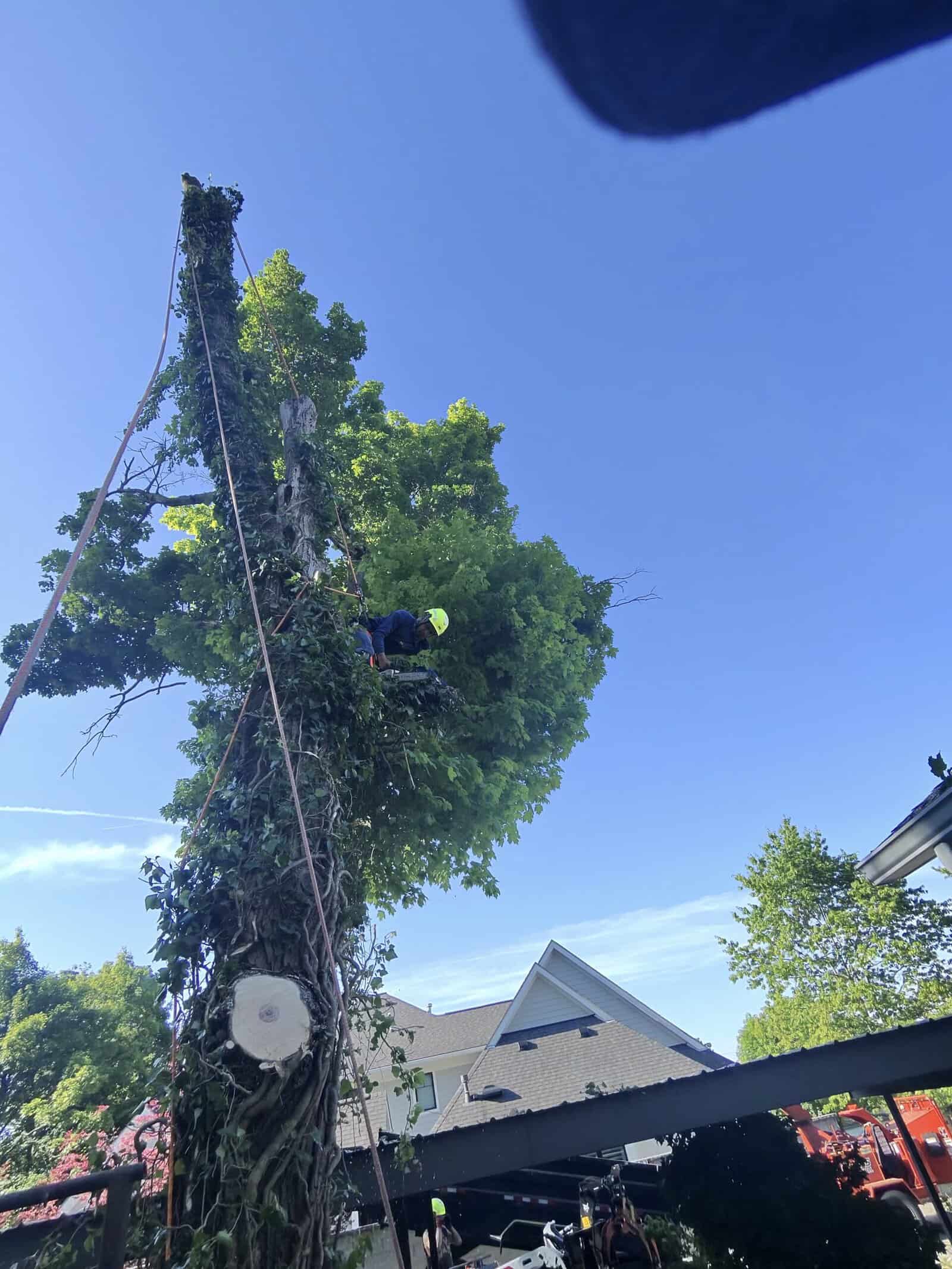
From there, our crew gets to work. For mature trees, that typically means crown thinning to reduce canopy density and wind resistance, crown reduction to bring oversized lateral branches back into proportion, or structural pruning to address co-dominant stems and weight distribution issues. For Livonia homeowners with oaks, timing matters — oak trees in Michigan need to be pruned between November 1 and March 31 to avoid oak wilt, a disease spread by sap beetles that become active once temperatures climb above 50 degrees. We know this and plan accordingly.
One thing worth knowing if your trees are near the street: Livonia requires a permit for tree work on public right-of-way trees, and a separate permit for removal on private property. We operate professionally within that framework and can help you understand what applies to your situation before any work starts.
When the job is done, our crew cleans up completely — debris removal, raking, full site restoration. You shouldn’t have to deal with anything left behind.
Ready to get started?
Tree pruning covers a range of specific techniques depending on what your trees actually need. Crown thinning selectively removes branches throughout the canopy to improve light penetration and airflow — and critically, to reduce the sail effect that makes dense, unpruned canopies vulnerable in high-wind events like the storms Livonia sees regularly. Crown reduction brings the overall size of the tree back into proportion by shortening lateral branches while maintaining the tree’s natural form — it’s the right alternative to topping, which is harmful, structurally damaging, and explicitly prohibited under ANSI A300 pruning standards. Deadwooding removes dead, dying, or structurally compromised branches before they become a hazard.
For Livonia’s mature residential trees — the 50 to 70-year-old maples, oaks, and elms lining streets from Newburgh Road to Merriman Road — these aren’t minor maintenance tasks. They require an arborist who understands tree biology and load distribution, not just someone comfortable at height. Our ISA Certified Arborists bring that knowledge to every job, and the TRAQ qualification means risk assessment on large trees near your home is done to a professional standard.
Every service includes a pre-work site walk, a written estimate, and complete post-job cleanup. If your trees are near the right-of-way, we’ll walk you through Livonia’s permit requirements so that part of the process is handled correctly from the start.
For pruning on your own private property, a permit is generally not required. But Livonia does require a permit for any tree work on public right-of-way trees — the trees in the strip between the sidewalk and the curb — and also for tree removal on private property. The permit is free for residents; if a contractor pulls it on your behalf, there’s a $30 fee. The permit isn’t official until it’s signed by City of Livonia forestry staff, so this isn’t something you want to skip or assume your contractor is handling without confirming.
If your tree is near the street, near a utility line, or you’re not sure whether it falls under the city’s jurisdiction, the safest move is to ask before any work starts. A contractor who’s familiar with Livonia’s ordinance will be able to tell you quickly what applies to your situation. We operate across Wayne County and understand these requirements — it’s part of working professionally in a city that takes its urban forestry program seriously.
Crown thinning and crown reduction are both legitimate pruning techniques, but they accomplish different things. Crown thinning removes selective branches throughout the canopy to improve light and airflow without significantly changing the tree’s overall size or shape. It’s particularly useful for dense, mature trees where the canopy has become so thick that wind can’t pass through cleanly — which increases the risk of branch failure or whole-tree failure in a storm. For Livonia’s older residential trees, thinning is often the first recommendation.
Crown reduction is different. It reduces the overall size of the tree by shortening lateral branches back to a lateral junction — maintaining the tree’s natural form while bringing it back into a safer, more manageable proportion. This is the correct approach when a tree has grown too large for its space, is encroaching on a roofline, or is creating clearance issues with power lines. It’s important to understand that crown reduction is not the same as topping. Topping — cutting branches back to stubs without regard for structure — is harmful, creates large open wounds that invite disease and decay, and is not a practice that credentialed arborists follow. If someone quotes you a topping job, that’s a red flag.
For most deciduous trees in Southeast Michigan, the dormant season — roughly late November through early March — is the optimal window. Late February into early March is the professional sweet spot: the tree is still dormant, which reduces stress and disease risk, but the ground is often accessible and the weather is beginning to cooperate. Without foliage, our crew can also see the tree’s full structure clearly, which makes assessment and cuts more precise.
Species timing matters significantly here. If you have oak trees, they must be pruned between November 1 and March 31 in Michigan. Oak wilt is spread by sap beetles that become active once temperatures rise above 50 degrees — and fresh pruning cuts are exactly the entry point those beetles use. It’s a serious, incurable disease, and the timing window exists for a reason. Maples are also best pruned in the dormant season; spring pruning can cause significant sap loss. If you’re not sure what species you’re working with or when to schedule, that’s part of what a pre-work site assessment covers.
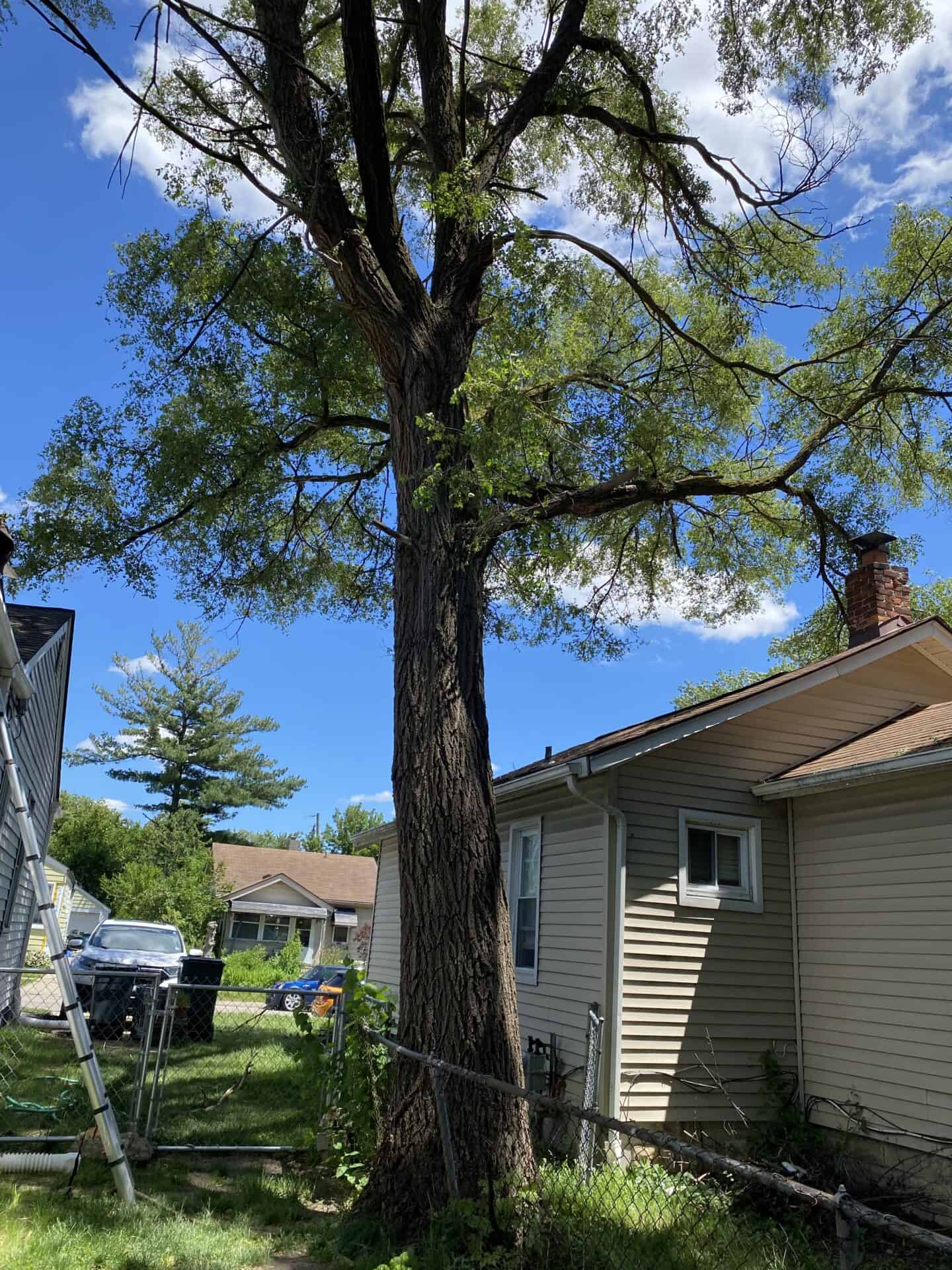
A few things are worth paying attention to. Dead or hanging branches — especially large ones over a roofline, driveway, or area where people walk — should be addressed promptly, not deferred. A canopy that’s become noticeably dense, where you can barely see light through the foliage from below, is a candidate for thinning. Branches that are growing toward your home, crossing and rubbing against each other, or showing signs of disease or decay are all reasons to get eyes on the tree sooner rather than later.
For Livonia homeowners specifically, the June 2024 tornado was a reminder that trees which look fine from the ground can have structural issues that only become apparent when wind loads are applied. Co-dominant stems — where two main trunks grow upward together at a tight angle — are a common structural weakness in mature trees that aren’t visible until something fails. A TRAQ-qualified arborist can assess that kind of risk properly. If your trees are 30 years old or older and haven’t been professionally evaluated recently, it’s worth scheduling a site walk before the next storm season, not after.
Yes, and it’s more common than most homeowners realize. The most damaging practice is topping — cutting the main branches back to stubs without regard for the tree’s structure. Topping creates large, open wounds that the tree struggles to compartmentalize, leaving it vulnerable to decay fungi, disease, and insect infestation. The regrowth that follows topping is typically fast, weakly attached, and structurally inferior to the original branches — meaning a topped tree is often more hazardous after the cut than before it.
Over-pruning is another real risk. ANSI A300 standards — the national benchmark for professional tree pruning — specify that no more than 25 percent of a tree’s live foliage should be removed in a single session for most mature trees. Removing more than that stresses the tree significantly, disrupts its ability to photosynthesize, and can trigger a decline that takes years to become visually obvious. Flush cuts, where branches are removed too close to the trunk and the branch collar is damaged, also compromise the tree’s natural wound response. These aren’t minor technical details — they’re the difference between a tree that recovers well and one that slowly deteriorates over the next decade.
Trees growing near or into overhead utility lines require a specific level of training and insurance that most general tree services don’t carry. We hold line-clearance certification — a specialized credential that covers the techniques, equipment, and safety protocols required for working near energized power lines. This isn’t the same as general tree trimming experience, and the insurance requirements are different as well.
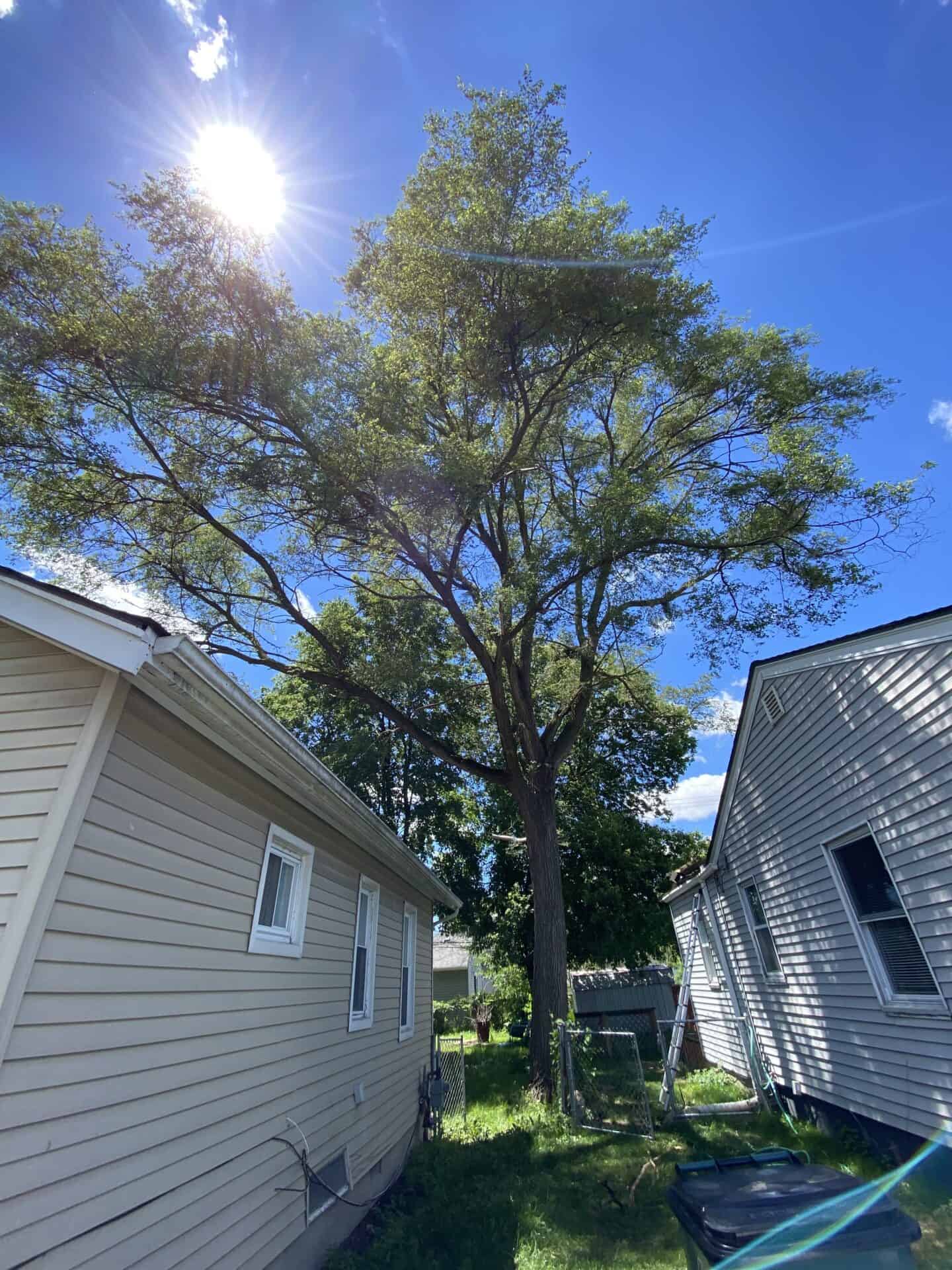
In Livonia, overhead utility lines run through residential neighborhoods throughout the city, and mature trees that have been growing for 50 or more years often have branches that have grown well into those corridors. Pruning those branches incorrectly — or without the right certification — creates real risk for our crew, for neighboring properties, and for utility infrastructure. If your tree is near a power line and a contractor tells you it’s not a concern or doesn’t mention their line-clearance credentials, that’s worth pressing on before you agree to any work. We’ll assess the situation during the site walk and let you know exactly what’s involved before anything starts.
Other Services we provide in Livonia
