Hear from Our Customers
The trees on most Bloomfield Hills properties predate the homes themselves. You’re not dealing with a young suburban tree that can be dropped in a clear yard — you’re dealing with massive root systems, tight canopy clearances, high-value structures nearby, and in many cases, utility lines running through or beneath the same corridor.
Getting this right matters. A removal done carelessly on an estate property in Bloomfield Hills can damage original architectural detail, tear up landscaped grounds that took years to establish, or create a safety hazard that costs far more to fix than the tree removal itself. What you actually want is a team that shows up, assesses the full picture, and executes the job without turning your property into a problem.
When the work is done right, the result is straightforward: the tree is gone, the area is clean, and your property looks the way it should. No debris pile left behind. No surprise damage. No lingering questions about whether the job was done safely or whether you’re now exposed to a code violation.
We’re a family-owned company based in Oakland, Michigan, serving Oakland County and the broader Southeast Michigan area — including Bloomfield Hills. I lead every field operation personally, and Cecilia handles scheduling, communication, and the administrative side of every job. When you call, you’re reaching real people who are accountable for what happens on your property.
Our team holds ISA Certified Arborist credentials and includes TRAQ-qualified risk assessors — the same standard that municipalities and insurers require for formal tree risk evaluations. We’re also trained and certified to work near energized power lines, which matters in Bloomfield Hills where mature trees along Woodward Avenue and local residential corridors regularly grow into utility easements. That’s not a capability most companies around here can actually claim.
With over seven years of experience across Southeast Michigan, we’ve worked on the kind of large, complex, estate-scale properties that define Bloomfield Hills. We’re fully licensed and insured, and every job starts with an on-site walkthrough — not a number guessed over the phone.
It starts with a free, no-obligation on-site estimate. Someone from our team comes to your property, walks the site with you, and takes a real look at what’s involved — tree size, proximity to structures, access points, root system concerns, and any power line considerations.
For a property in Bloomfield Hills, that walkthrough also includes a conversation about the city’s woodland ordinance. Under Chapter 22 Article II, every tree removal requires a building department plan review before work begins. Depending on your parcel size, you may also need a formal permit. We handle that process on your behalf so you’re not navigating city code on your own.
Once the scope is clear and the paperwork is in order, our crew arrives with the right equipment for the job. Large canopy trees on estate lots require controlled rigging and careful drop-zone planning — especially when structures, fencing, or landscaped beds are nearby. We work methodically, not quickly for the sake of it, and every cut is made with the surrounding property in mind.
When the tree is down, the job isn’t finished. Every removal includes complete debris removal and full site cleanup before we leave. Logs, brush, chips — it all goes. You shouldn’t have to look at the aftermath of the job for days after the work is done. The goal is to leave your property clean and undisturbed, the way you’d expect from anyone working on a Bloomfield Hills estate.
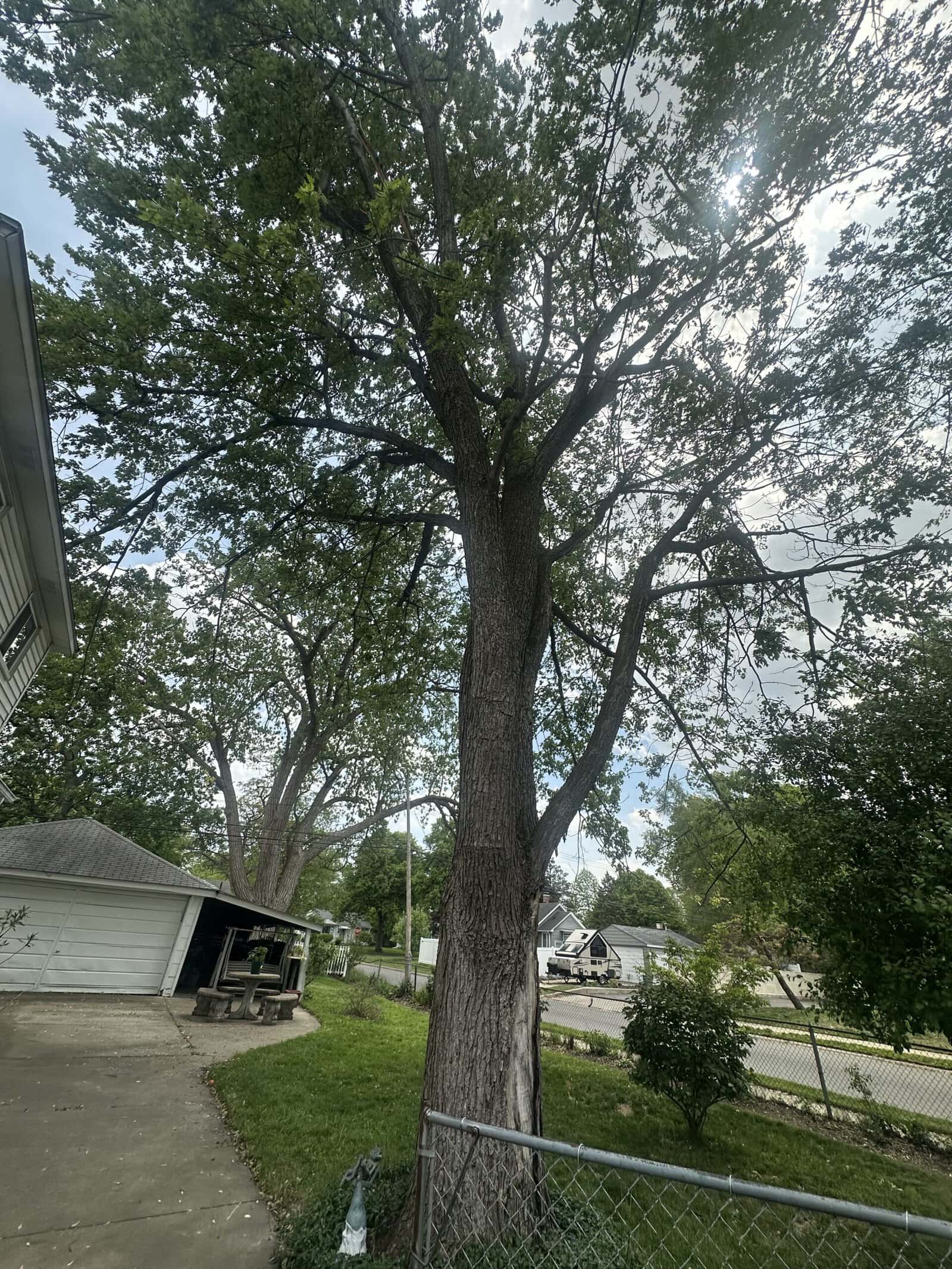
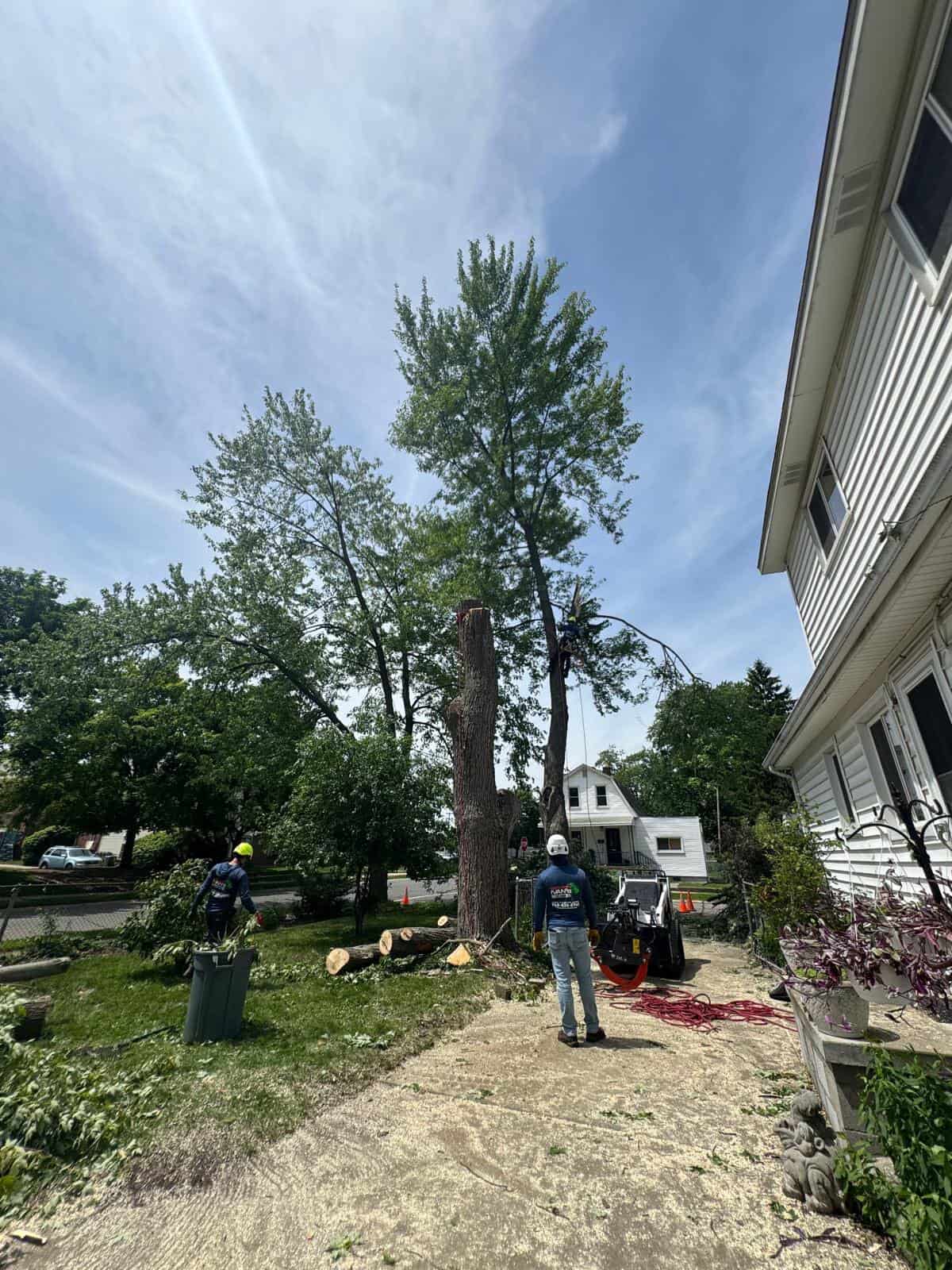
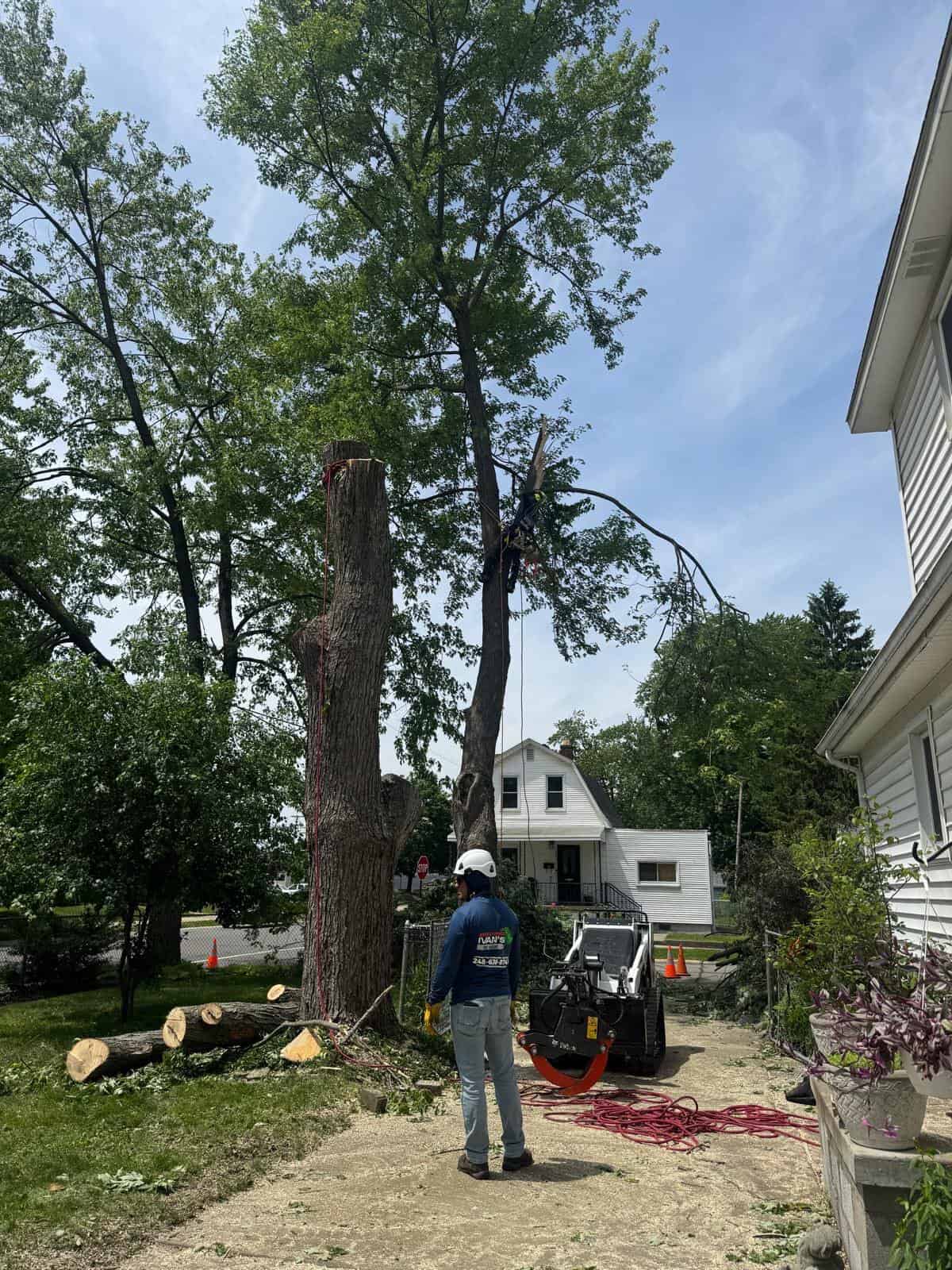
We handle the full range of tree removal needs in Bloomfield Hills — from planned removals of dead or structurally compromised trees to emergency response after a storm event. Southeast Michigan’s weather patterns hit Bloomfield Hills hard. Spring thaw-line winds uproot shallow-rooted oaks when the ground is still saturated. Summer microbursts off Lake Erie drop limbs across entire neighborhoods in minutes. Winter ice loading stresses the large crown spreads that are common on hundred-year hardwoods throughout the city. When something fails, our 24/7 emergency tree removal service means you’re not waiting until Monday to get a response.
For dead tree removal in Bloomfield Hills, it’s worth knowing that the city’s ordinance defines a dead or dying tree specifically — a tree qualifies only if it has less than 50% of its canopy during the growing season. That distinction matters when you’re working through the permit process, and it’s one of the things we address during the initial walkthrough. The Emerald Ash Borer has left a significant number of dead ash trees on Oakland County properties, and ash is explicitly listed as a removable nuisance species under the Bloomfield Hills ordinance, which simplifies the permit path for those specific removals.
Beyond tree removal, we also offer stump grinding, lot clearing, and complete site restoration. Stump removal is a separate service from tree removal — something many homeowners don’t realize until after the fact — and it’s worth discussing during the estimate so the final result matches what you’re actually expecting.
Yes, and the rules are more involved than most homeowners expect. Under Chapter 22 Article II of the Bloomfield Hills city code, every tree removal requires a building department plan review before any work begins — there are no exceptions for routine removals.
Beyond that, the number of trees you can remove without a formal permit depends on your parcel size. If your lot is under 1.5 acres, you can remove up to two trees without a permit. If your lot is over 1.5 acres, that threshold goes up to three trees. Remove more than that without the proper permit, and you’re looking at a code violation that the city actively enforces.
There’s also a separate category for Landmark Trees — trees of exceptional size, age, or significance that carry stronger protections and require a more involved permit process before removal. If you’re not sure whether a tree on your property qualifies, that’s exactly the kind of question the on-site walkthrough is designed to answer. Our team walks through the ordinance requirements as part of every estimate so you understand what’s needed before any work starts.
The city’s ordinance is specific on this point, and it’s different from how most people think about a “dead” tree. Under Bloomfield Hills’ Chapter 22 Article II, a tree is considered dead or dying only if it has less than 50% of its canopy present during the growing season. A tree that looks rough, has some dead branches, or has suffered storm damage doesn’t automatically qualify under that definition — and removing it without meeting the ordinance’s threshold can put you in violation.
This matters practically because it affects how the permit process works and what documentation you’ll need. The ordinance also requires photographic documentation of damaged or dead trees before removal proceeds. If you believe a tree on your property is dead or dying and want to remove it, the safest approach is to have a certified arborist assess it first and document the condition properly. Our team includes ISA Certified Arborists who can evaluate the tree, confirm whether it meets the ordinance’s definition, and help you move through the permit process correctly.
Some warning signs are visible — a new lean after a storm, cracks in the main trunk, exposed or heaving roots, large dead limbs hanging in the canopy. But some of the most serious structural problems aren’t visible from the outside at all. Internal decay, root system damage from construction or soil compaction, and split trunks hidden beneath bark can all represent genuine failure risks without showing obvious external symptoms.
In Bloomfield Hills, this is especially relevant given the age of the tree canopy. Many properties here feature oaks and maples that are 80 to 100 years old. Trees of that age can have internal conditions that aren’t apparent until something fails — and when a tree that size comes down near a high-value structure, the consequences are significant. A TRAQ-qualified risk assessment uses a formal, science-based methodology to evaluate structural integrity and determine actual risk level, rather than relying on visual guesswork. Our team includes TRAQ-qualified assessors, which means the evaluation you get is based on a documented standard, not an opinion.
It can, but only by a crew that’s trained and certified to work near energized lines — and that’s a shorter list than most homeowners realize. Many tree service companies will decline jobs that involve utility proximity, or they’ll attempt the work without the proper protocols, which creates serious risk for the crew and the property.
In Bloomfield Hills, this is a real and recurring situation. Mature trees throughout the city grow along Woodward Avenue and local residential corridors where overhead utility lines run through the same space. DTE Energy has been actively managing its infrastructure in Bloomfield Hills — including documented equipment installations at Pine Tree Trail and Karen Lane — and the intersection of large canopy trees and live utility lines is a consistent part of the landscape here. Our team holds specific power line proximity training and is certified to work in these conditions. If a tree on your property is near utility lines and other companies have turned the job down or given you a vague answer about it, that’s exactly the kind of work we’re equipped to handle.
Tree removal and stump removal are two separate services, and this surprises a lot of homeowners. When a tree is cut down, the stump and the root system remain in the ground unless stump grinding is specifically included in the scope of work. If you don’t address it, you’re left with a ground-level stump that can be a tripping hazard, an obstacle for mowing, and on some properties, an eyesore in an otherwise maintained landscape.
Stump grinding uses specialized equipment to grind the stump down below grade, leaving the area level and ready for grass, mulch, or replanting. On Bloomfield Hills estate properties where landscape presentation matters, leaving a visible stump behind after a removal isn’t usually an acceptable outcome. The best time to discuss stump grinding is during the initial estimate — that way the full scope is clear before work begins, and the final result is what you actually expected. We offer stump grinding as part of our full service range, and our team can walk you through what the finished area will look like based on the specific tree and location.
It depends on the circumstances, and the details matter. In general, homeowners insurance may cover tree removal if a tree falls as a result of a covered event — like a windstorm or lightning strike — and damages a structure on your property, such as your home, garage, or fence. If the tree falls but doesn’t damage a structure, most policies won’t cover the removal cost, even if the tree is blocking your driveway or creating a hazard.
There’s also an important timing consideration that many homeowners in Bloomfield Hills overlook: removing a fallen tree before an insurance adjuster has a chance to document the damage can void your claim. If a storm brings down a large tree on your property and you think there may be an insurance component, it’s worth calling your insurer before the tree is moved. Our team can respond quickly for emergency stabilization and documentation without removing the tree entirely until you’ve had a chance to work through the claims process. That kind of coordination is part of what separates a professional service from a crew that just shows up and starts cutting.
Other Services we provide in Bloomfield Hills
