Hear from Our Customers
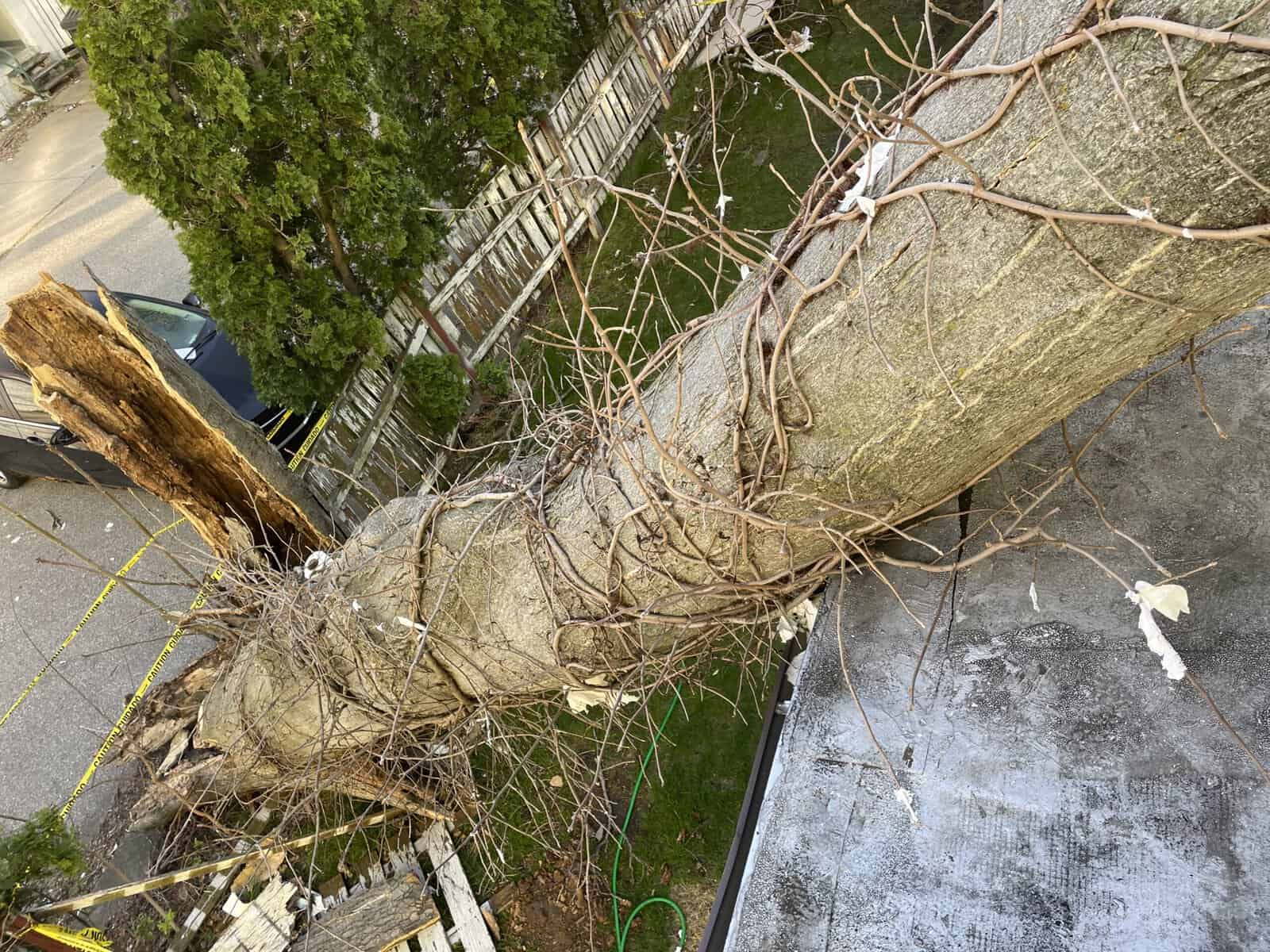
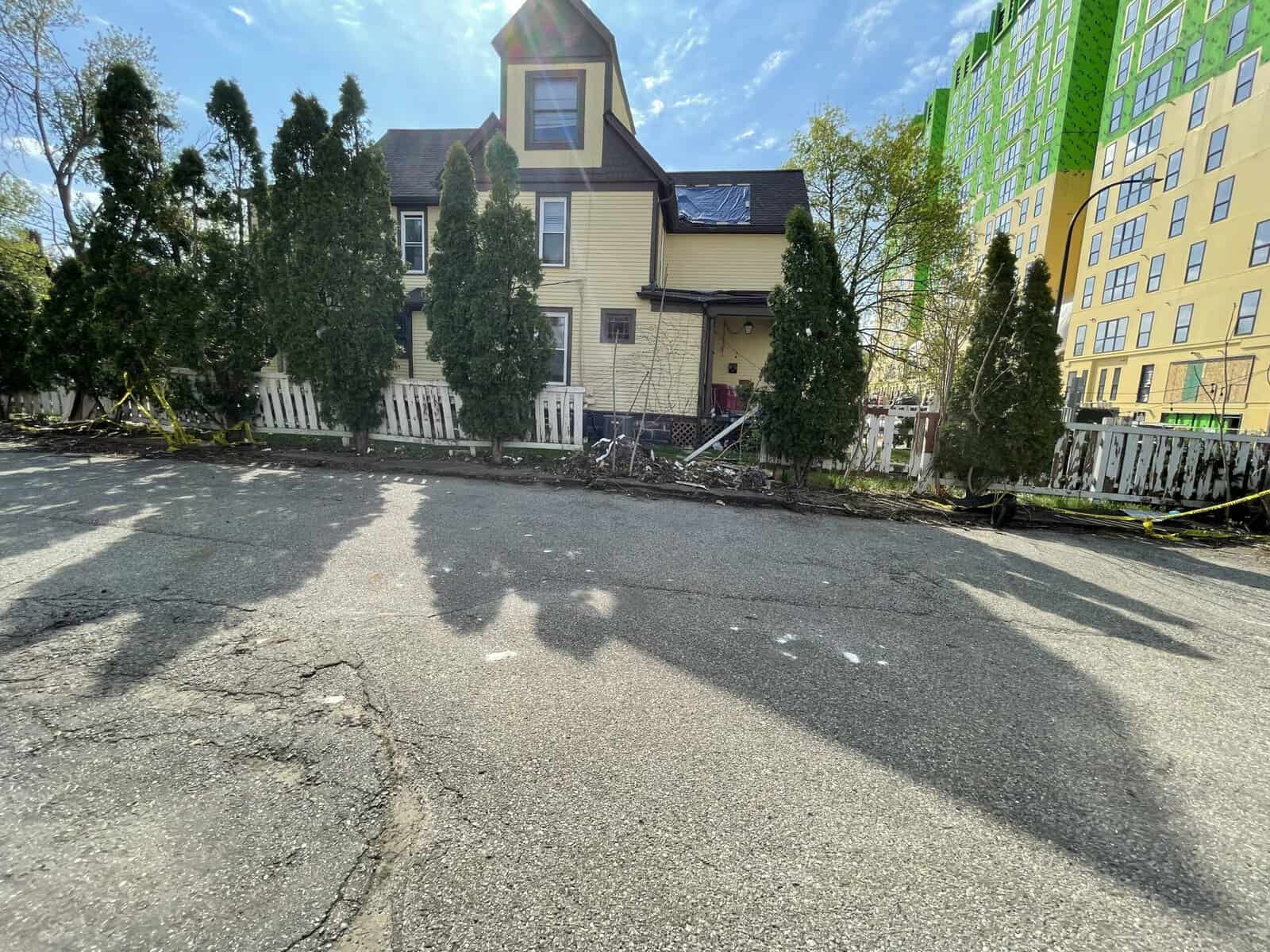
South Lyon residents don’t need a lecture on storm risk. The August 2023 storm system hit this city hard enough to trigger a local disaster declaration, a county declaration from Oakland County Executive Dave Coulter, and a governor-signed state of emergency — Executive Order 2023-8 — that named South Lyon by name. Trees and power lines came down across the city, concentrated on the west side of Lafayette Street and south of Lake Street. If you were here for that, you already know what it looks like. What you want to know now is who shows up when it happens again.
We handle the full picture — fallen tree removal, hazardous limb removal, emergency tree clearing, and post-storm assessment — so you’re not left managing a dangerous situation on your own. Every job includes a face-to-face site walkthrough before any work begins, a written estimate, and a clean property when the crew leaves. No debris left on the lawn, no surprises on the invoice.
South Lyon’s position at the western edge of Oakland County means storms arrive with less natural attenuation than communities further east toward Metro Detroit. That wind exposure hits the mature trees lining the historic blocks near Lafayette and Lake streets especially hard — trees with large canopies, decades of growth, and the structural complexity that comes with age. When those trees fail, they don’t fall clean. They fall into power lines, onto rooflines, and across driveways. Getting them out safely takes more than a chainsaw.
We’re based in Oakland, MI — about 10 to 15 miles north of South Lyon via Oakland Road. That’s not a long drive under normal conditions, and it’s a direct route we know well. When Oakland County gets hit, Oakland gets hit too. This isn’t a company dispatching from across the state or routing calls through a national call center with a Texas area code. It’s a locally rooted operation with real skin in the game.
What separates us from most of the tree services you’ll find after a storm in South Lyon is the credentials behind our crew. ISA Certified Arborists are on every significant job. TRAQ-qualified risk assessors — holding the Tree Risk Assessment Qualification — are available to evaluate trees that look stable but may not be. And critically, our arborists hold line-clearance certification, which is the specialized training and insurance required to work safely near energized power lines. After what South Lyon experienced in August 2023, when trees came down onto utility lines throughout the city, that credential isn’t a nice-to-have. It’s the difference between a crew that can work and one that has to wait for DTE to clear the scene first.
When you call us — any hour, any day — the first thing that happens is a real conversation. You describe what you’re dealing with: a tree on the roof, a hanging limb over the driveway, a root-heaved trunk that’s been leaning since the last storm. Based on what you share, we determine whether this is an immediate emergency response or a same-day assessment, and we communicate that clearly before anyone shows up.
Once on-site, an ISA Certified Arborist walks the property with you. This isn’t a quick glance from the truck — it’s a detailed walkthrough that accounts for what’s visible and what isn’t. In South Lyon, that means paying attention to the Huron River corridor and the greenway properties along the Huron Valley Trail, where saturated soil after a heavy rain event can quietly compromise a tree’s root anchoring even when the tree looks perfectly upright. A tree standing in waterlogged ground can fail days after a storm with no wind involved. The walkthrough catches that.
After the assessment, you get a written estimate. Work doesn’t begin until you’ve reviewed it and agreed. Then we handle removal, debris clearing, and full site cleanup — including stump grinding if that’s part of the scope. Michigan doesn’t require a state license to operate a tree service, which means the permit and credential burden falls on the homeowner to verify. With us, that verification is straightforward: ISA certification, TRAQ qualification, line-clearance credentials, and proof of insurance are all part of the package before the first cut is made.
Ready to get started?
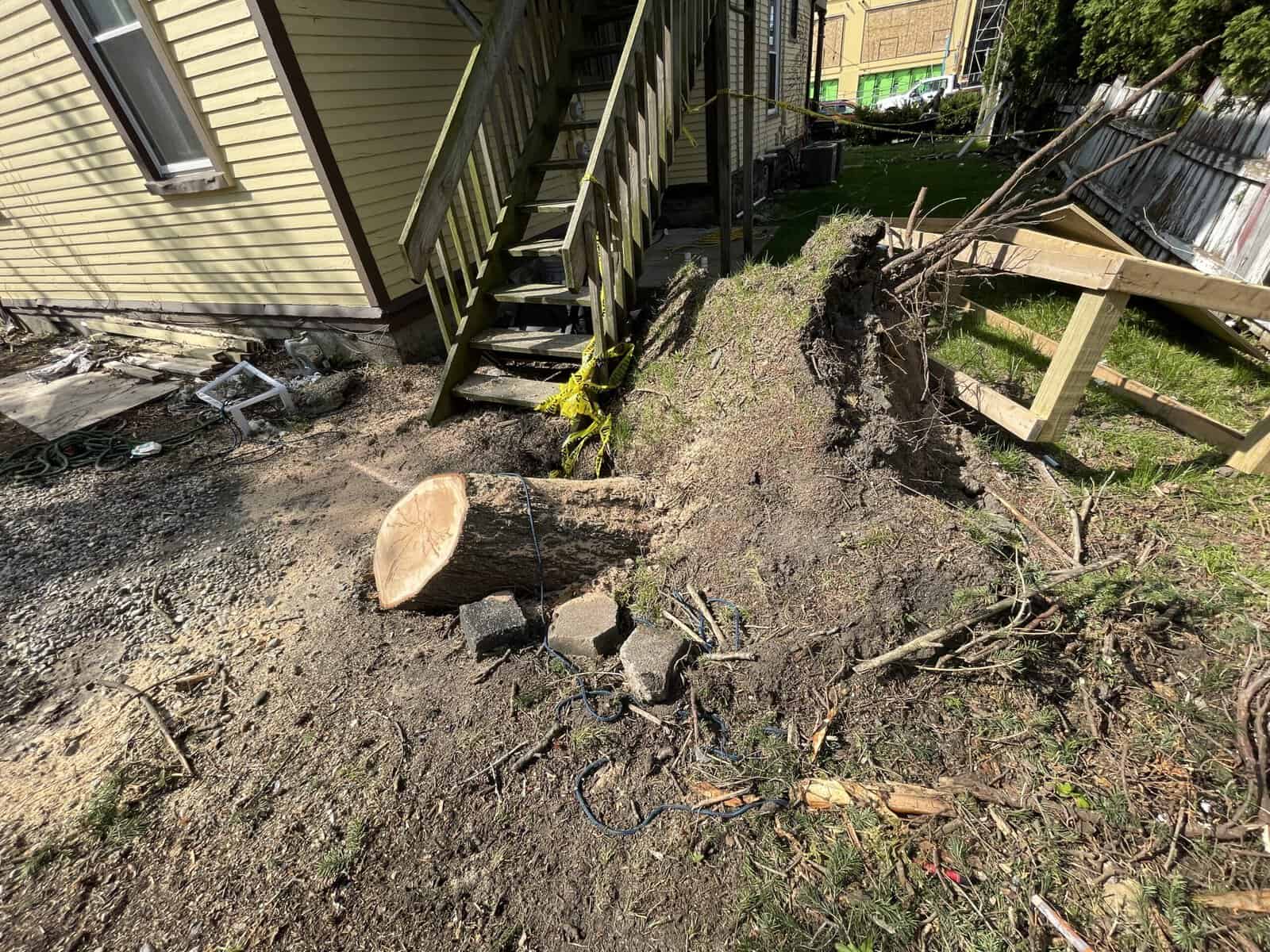
We handle the full range of what storm damage actually looks like in South Lyon — not just the obvious cases where a tree is lying across a car, but the subtler ones that are just as dangerous. Hazardous limb removal covers the widow-makers: large branches that are partially attached, hanging under tension, and can drop without warning. These are common after the kind of compound storm events South Lyon sees regularly, where high winds and hail hit in the same system. A limb that looks like it’s holding may be one warm afternoon away from coming down on a fence, a vehicle, or a person.
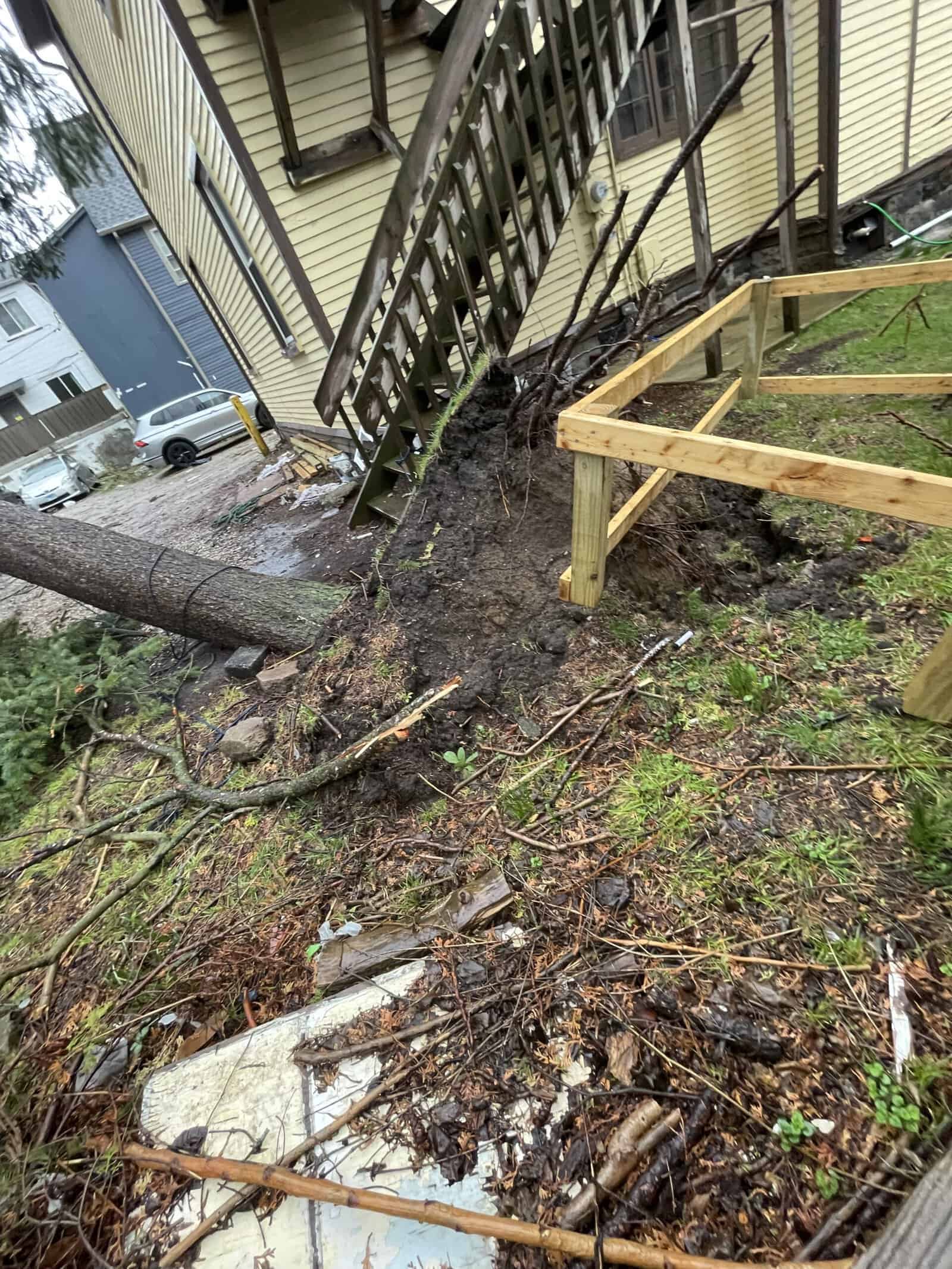
For the larger emergencies — a fallen tree blocking Pontiac Trail access, a root ball that’s lifted out of the ground near a Hidden Lake property, or a split trunk threatening a historic home in the downtown residential grid — we bring the rigging expertise and equipment to control the removal precisely. Tight lots, overhead utility lines, and historic structures demand that kind of controlled approach. This is not a situation where brute force and speed are the right tools.
Our service also includes 24 hour emergency tree service for situations that can’t wait, storm damage cleanup that covers the full debris field, and emergency tree clearing for access blockages. After the primary work is done, stump grinding and topsoil restoration are available to bring the property back to a clean, usable state. For South Lyon homeowners in HOA-governed communities like Hidden Lake or Trotters Pointe, that final condition matters — both for safety and for compliance with community standards.
It depends on whether the tree damaged a structure. Standard homeowners insurance policies typically cover tree removal when a fallen tree has damaged something covered under the policy — your roof, your fence, your garage. In those cases, most policies include a sublimit specifically for tree removal, often in the range of $500 to $1,000 per storm event, or up to a percentage of your dwelling coverage if structural damage is involved. If the tree fell in the yard and didn’t hit anything, coverage is less common, and many South Lyon homeowners are surprised to find they’re paying out of pocket for removal even after the declared disaster event in August 2023.
The practical advice is to document everything before any cleanup begins. Take photos and video of the tree, the damage, the surrounding area, and any structures affected. Call your insurance provider to open a claim and ask specifically what documentation they need from the tree service company. We provide written estimates and detailed job records that can support an insurance claim. If you’re unsure where to start, call us first — we can help you understand what’s in front of you before you commit to anything.
This is one of the most important questions to get right, and it’s genuinely hard to answer without a trained eye. A tree that looks stable after a storm may have internal damage that isn’t visible from the ground — a cracked trunk, a compromised root plate, or a main scaffold branch that’s hanging by a thread of bark. Conversely, a tree that looks alarming — leaning slightly, with some broken branches — may be structurally sound and worth saving.
In South Lyon specifically, the Huron River corridor and the greenway properties along the Huron Valley Trail add another layer of risk. After a heavy rain event, the surrounding soil can become saturated enough that a tree’s root anchoring is significantly weakened — even if the tree itself is healthy. That’s a condition that doesn’t show up in a casual inspection. We have TRAQ-qualified risk assessors on staff — that’s the Tree Risk Assessment Qualification from the ISA — who conduct professional, documented evaluations of storm-damaged trees. The assessment tells you clearly whether a tree is safe to leave, needs pruning, or needs to come down. It eliminates the guesswork that can turn a “wait and see” decision into a very expensive emergency.
The first thing is to stay away from it. If the tree is near power lines — or if you’re not certain whether it’s touching a line — treat the entire area as energized and keep everyone back. In South Lyon’s residential grid, especially on the blocks near Lafayette Street and Lake Street where overhead utilities run through nearly every yard, this is a real concern. Don’t assume a line is dead because the power is out. Call 911 if there’s any immediate danger to people, and call DTE Energy to report downed lines.
Once the immediate safety situation is addressed, document the damage thoroughly before anything is moved or cleaned up. Photos and video from multiple angles will support any insurance claim you file. Then call a tree service with the credentials to actually handle what you’re looking at — particularly if the tree is near utility lines, which requires line-clearance certified arborists, not just a standard removal crew. We offer 24 hour emergency tree service across Oakland County and can assess the situation, provide a written estimate, and begin work as soon as it’s safe to do so.
Michigan does not require a state license to operate a tree service, and in most cases, emergency storm damage removal does not require a permit from the city. When a tree has fallen and poses an immediate safety hazard, the urgent nature of the situation generally exempts it from standard permitting timelines. That said, South Lyon does have a documented tree ordinance on file with the Michigan DNR, and specific situations — particularly involving landmark or historic trees, or trees in the road right-of-way — may involve additional steps.
Right-of-way trees in South Lyon fall under the Road Commission for Oakland County, not the property owner. If the tree that came down is in the strip between the sidewalk and the street, the RCOC has jurisdiction over that removal, and their process involves a separate coordination step. It’s worth clarifying this early, because a homeowner who removes a right-of-way tree without RCOC involvement can face complications. We walk through the site with you before any work begins specifically to identify these kinds of jurisdictional questions — so you’re not caught off guard after the fact.
We’re based in Oakland, MI, which is approximately 10 to 15 miles north of South Lyon via Oakland Road — a direct route that doesn’t require navigating major urban traffic. For genuine emergencies, our 24 hour availability means someone answers the phone regardless of the hour, and response time is driven by the severity of the situation. A tree on a roof or a limb blocking access to a home gets prioritized differently than a tree down in an open yard with no structural contact.
After a widespread storm event — the kind South Lyon has experienced, where multiple properties across the city are dealing with damage simultaneously — demand spikes and response windows naturally extend. The honest answer is that every credentialed tree service in Oakland County gets stretched thin after a major storm. What matters in those situations is that you’re on the list with a company that actually shows up and does the job right, rather than holding a verbal promise from a crew that materialized in the neighborhood the morning after the storm and disappears once they’ve collected a deposit. Our written estimate process and pre-job site walkthrough exist precisely to protect you in that environment.
Not every storm-damaged tree needs to come down, and a good arborist will tell you that honestly rather than defaulting to removal because it’s the simpler job. The decision depends on what kind of damage the tree sustained, where the damage is located structurally, and what the tree’s long-term health and risk profile looks like. A tree that lost a major limb but has an intact, healthy trunk and a stable root system may be a strong candidate for corrective pruning and continued growth. A tree with a split trunk, significant root heave, or internal decay exposed by storm damage is a different conversation.
In South Lyon, the mature trees in the historic downtown residential blocks — the ones lining the older streets near Lake and Lafayette — are worth evaluating carefully before removing. These are established trees with real canopy value, and losing them changes the character of those properties permanently. At the same time, a compromised tree in a tight lot with a historic home on one side and utility lines on the other is not a situation where optimism should override a professional assessment. Our ISA Certified Arborists give you an honest read on what the tree’s condition actually is, what the realistic options are, and what the risk looks like if you choose to keep it. That’s the conversation you want before you decide either way.
Other Services we provide in South Lyon
