Hear from Our Customers
Tree removal in Brighton isn’t the same job it is in a flat, open suburb. Properties here — whether you’re in Pine Creek Ridge with a mature oak overhanging Brighton Lake, or in Harvest Hills with a storm-damaged ash tree leaning toward your fence line — come with real complexity. Wooded lots, sloped glacial terrain, lakefront exposure, and trees that have been growing for 50 or 60 years are the norm here, not the exception. We’re built for exactly this kind of work.
When the job is done right, you’re not just rid of a tree. You’re rid of the liability that came with it. A dead or structurally compromised tree in a Livingston County wooded neighborhood isn’t just an eyesore — it’s a falling hazard waiting on the right wind event. After a clean, professional removal, that risk is gone. The property is clear. The debris is hauled away. The stump is addressed. Your lawn doesn’t look like a logging operation rolled through.
Brighton’s oak-hickory woodland sits in an active oak wilt zone. Genoa Township — right next door — has issued formal guidance on how dead oaks need to be removed and disposed of to prevent the disease from spreading through root contact to neighboring trees. We handle removal the way it needs to be handled to protect the trees you’re keeping, not just eliminate the one you’re losing. That’s the difference between a company that knows this area and one that doesn’t.
We’re a family-owned operation based out of Oakland, Michigan — roughly 15 to 20 miles from Brighton along the same wooded, lake-adjacent corridor that defines this part of Southeast Michigan. Ivan leads every field operation personally. Cecilia manages scheduling, communication, and the administrative side — which means when you call, you get a real answer and a real timeline, not a callback that never comes.
Our team includes ISA Certified Arborists and TRAQ-qualified risk assessors. Those aren’t just credentials to list — TRAQ certification means we use a formal, science-backed methodology to determine whether a tree poses a genuine structural risk. That matters when you’re dealing with a 70-foot oak in Pine Creek Ridge and you’re not sure if it needs to come down or if it can be saved. You get an honest answer, not a removal recommendation driven by what’s most profitable.
We’re also specifically trained and certified to work near electric poles and power lines — a capability that most local operators simply don’t have. In Brighton’s established neighborhoods, where mature trees frequently grow into utility corridors, that’s not a minor detail. It’s the difference between a job that gets done safely and one that shouldn’t have been attempted at all.
It starts with an on-site walkthrough. We don’t quote over the phone and don’t start work without seeing the property first. Someone from our team comes out, assesses the tree — its size, its condition, its proximity to structures, power lines, or water — and walks you through what we’re seeing. If you’re dealing with a tree that shows signs of oak wilt or EAB damage, that gets flagged during the assessment too. You’ll know exactly what you’re dealing with before any decision is made.
One thing worth knowing if you’re in Brighton: the City of Brighton has a tree ordinance under Chapter 94 of its municipal code, and many of the planned subdivisions throughout the area — Pine Creek Ridge, Oak Pointe, and others — have HOA restrictions on tree removal. Before any work begins, it’s worth confirming whether a permit or HOA approval applies to your situation. We can help you navigate that question rather than leaving you to figure it out on your own.
Once the scope is clear and you’ve approved the written estimate, our crew gets to work. Trees near structures, fences, or lakefront areas are handled with rigging and controlled lowering — not just dropped and hoped for. After the tree is down, the site is cleaned completely. Logs, brush, chips — all of it goes. You’re not left managing the aftermath. If stump grinding is part of the job, that’s handled before the crew leaves. The property looks like a property again, not a worksite.
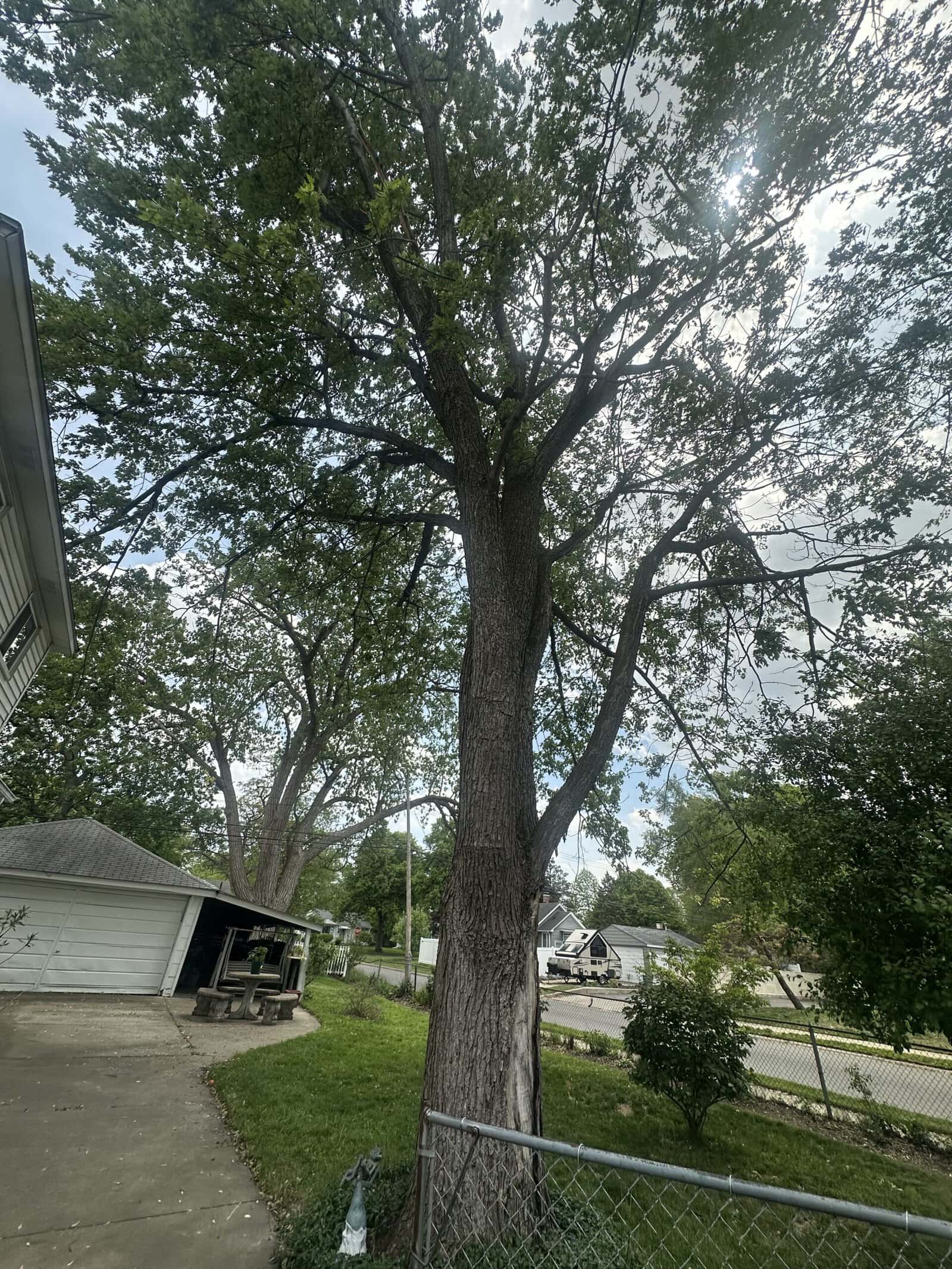
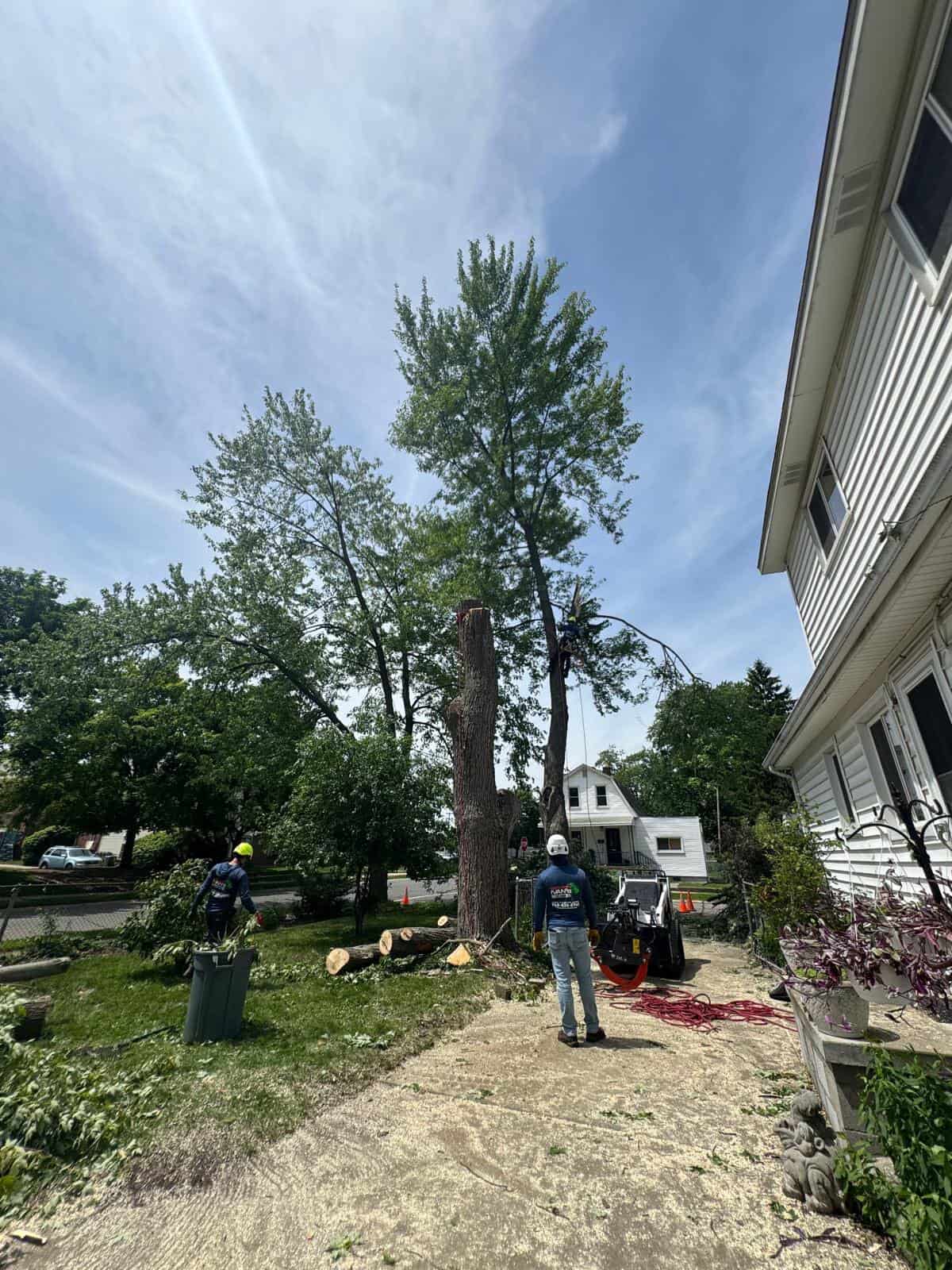
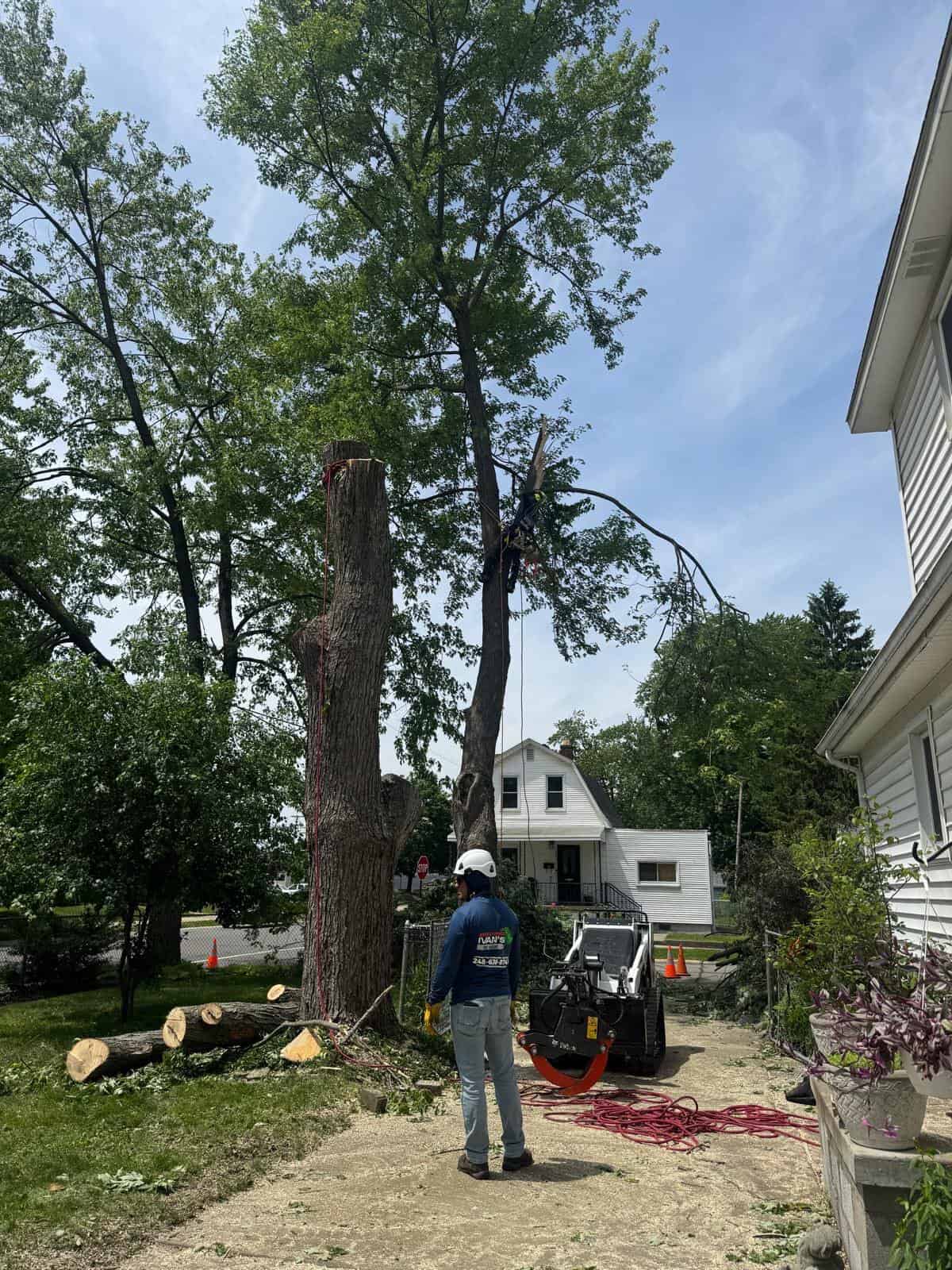
The tree issues Brighton homeowners face aren’t generic. Oak wilt is an active, documented threat in this area — and it spreads underground through root grafts between neighboring trees. If a red oak on your property is infected, leaving the stump in place after removal keeps that underground connection intact. Genoa Township’s formal oak wilt guidance specifically calls for stump removal and proper wood disposal — chipping or debarking — to break the disease cycle. Our full-service removal covers exactly that: tree, stump, and complete debris cleanup, handled the way it needs to be to protect the rest of your canopy.
Emerald ash borer has also worked through this part of Livingston County. EAB-killed ash trees are particularly deceptive — they can look borderline alive on the outside while their internal structure has deteriorated to the point of sudden failure. If you have mature ash trees on your property that haven’t been assessed recently, that’s worth addressing before a wind event makes the decision for you.
We handle emergency tree removal in Brighton around the clock — 24 hours a day, seven days a week. Brighton’s lakefront neighborhoods sit on open water with limited windbreak, and Michigan’s spring thunderstorms and winter ice events don’t wait for business hours. Dead tree removal, hazardous tree removal, storm cleanup, stump grinding, and lot clearing are all part of what we handle here. Every job includes a free on-site estimate, and nothing starts without a written scope you’ve reviewed and approved.
The City of Brighton has a tree ordinance codified in Chapter 94, Article II of the city’s municipal code. That ordinance primarily governs public trees — street trees, park trees, and trees on city-owned property — rather than trees on private residential lots. That said, large or heritage trees can trigger local permit requirements depending on diameter and species, and Michigan’s general threshold for permit consideration is typically around a 6-inch trunk diameter at breast height.
If you live in one of Brighton’s planned subdivisions — Pine Creek Ridge, Oak Pointe, Harvest Hills, and many others — your HOA may have its own restrictions on tree removal that operate separately from the city’s ordinance. Removing a tree without required HOA approval can result in fines. Before any work begins, we’ll help you identify whether a permit or HOA sign-off applies to your situation so you’re not caught off guard after the fact.
This is one of the most common questions, and it’s a fair one — not every tree that looks bad needs to come down, and not every tree that looks fine is safe. The honest answer is that a visual assessment from the ground only tells part of the story. Internal decay, root damage, and structural weakness from disease or storm stress can exist without obvious external signs. That’s why we conduct an on-site walkthrough before making any recommendation.
For Brighton homeowners specifically, two conditions are worth knowing about. First, if you have red oaks showing signs of wilting or discoloration, oak wilt is a real possibility in this area — and infected trees typically do need to come down, along with the stump, to prevent underground spread to neighboring trees. Second, EAB-killed ash trees often retain enough of their appearance to be mistaken for stressed-but-alive trees, when structurally they may already be at failure risk. An ISA Certified Arborist can tell the difference. If the tree can be saved with trimming, cabling, or treatment, that’s what you’ll hear — not a removal pitch.
It can be, but only with a crew that is specifically trained and certified to work in proximity to electrical infrastructure. This isn’t a job for a general tree crew with a chainsaw and good intentions. Trees growing into or near utility corridors require controlled removal techniques — specific rigging, sectional lowering, and coordination with the utility situation — that an uncertified operator isn’t equipped to handle safely. If something goes wrong near an energized line, the consequences aren’t just property damage.
Brighton’s established neighborhoods have mature trees that have been growing for decades, and in many cases those trees have grown directly into utility corridors along residential streets and lakefront properties. We’re specifically trained and certified for power line proximity work — a capability that most local operators don’t have and don’t advertise. If your tree is anywhere near a power line, that’s the first thing to confirm when you’re evaluating which company to call. It’s not a standard service. Make sure whoever you hire can actually do it safely.
First, don’t remove the tree before contacting your homeowners insurance company. If the tree fell due to a covered event — a windstorm, for example — your policy may cover some or all of the removal cost, particularly if the tree damaged a structure. Removing the tree before an insurance adjuster can document the scene can complicate or void that claim. Take photos first, call your insurer, and then call a tree service.
Second, if the situation is actively dangerous — a tree on a roof, blocking access, or leaning against a structure under tension — that’s an emergency. We offer 24/7 emergency tree removal in Brighton for exactly these situations. Brighton’s lakefront neighborhoods and wooded subdivisions take real hits during Michigan’s spring thunderstorm season and winter ice events, and a fallen tree near a dock, boathouse, or home exterior isn’t something you want sitting for three days waiting on a crew. We respond around the clock, assess the situation safely, and handle the removal and cleanup so you’re not left managing it.
Dead trees can be removed year-round — there’s no season where removal isn’t possible. That said, timing does matter for a few specific reasons in Brighton. If you have oaks that are diseased or dead from oak wilt, the April through July window is the highest-risk period for sap beetle activity, which is how oak wilt spreads from fresh wounds to healthy trees nearby. Professional removal during this window requires careful handling — no fresh cuts left exposed, proper debris disposal — to avoid accelerating spread. Outside that window, the risk is lower, but the removal protocol for oak wilt trees remains the same regardless of season.
For EAB-killed ash trees, there’s no seasonal restriction on removal, but there is urgency. Ash trees killed by emerald ash borer deteriorate structurally faster than most homeowners expect. A tree that looked manageable in the fall can be significantly more brittle and unpredictable by the following spring. Winter removal — when the tree is dormant and the ground is frozen — can actually make access easier on some Brighton properties with soft or sloped terrain. If you’ve been putting off an ash tree removal, sooner is almost always the better call.
Every job starts with a free, no-obligation on-site estimate. We don’t quote blind over the phone because the factors that determine cost — tree height, trunk diameter, proximity to structures or power lines, site access, whether stump grinding is needed, and how much debris needs to be hauled — can only be assessed in person. A number thrown out without seeing the property isn’t a real quote; it’s a placeholder that tends to change once the crew shows up.
Brighton properties add specific variables that affect scope. Lakefront access in neighborhoods like Pine Creek Ridge or Grand Beach can limit equipment positioning. Trees on sloped glacial terrain require different rigging than flat-lot removals. Oak wilt or EAB-affected trees require specific disposal handling that factors into the job. All of that gets accounted for in the written estimate before any work begins — no surprises added after the fact. We’ve consistently been the most competitive quote among multiple bids for Brighton-area homeowners, not by cutting corners on crew, equipment, or cleanup, but by being straightforward about what the job actually costs from the start.
Other Services we provide in Brighton
