Hear from Our Customers
When a tree comes down the right way, you barely notice the work happened — except that the risk is gone. No debris pile on the lawn, no damage to the fence, no lingering stump to mow around. That’s what a properly executed removal looks like, and it’s what you should expect every time.
In neighborhoods like Burns Park and Old West Side, where mature trees grow close to older homes and overhead utility lines are part of the landscape, the stakes are higher than they are in newer subdivisions. A tree that fails on its own doesn’t just create a mess — it can take out a roofline, a power line, or a fence that costs thousands to repair. Getting ahead of that is the smarter move.
Ann Arbor sits squarely in Michigan’s severe storm corridor. The spring and summer thunderstorm events that roll through Washtenaw County aren’t rare — they’re annual. When a storm drops a tree on your property at midnight, you need a team that actually picks up the phone. That’s the outcome that matters most when the situation is urgent.
We’re a family-owned operation based in Southeast Michigan, built over the past seven years. I run every job in the field. My fiancée Cecilia handles scheduling, communication, and the details that make the experience smooth from the first call to the final cleanup. You’re not dealing with a call center or a franchise — you’re dealing with the people who actually do the work.
Our credentials are real and verifiable. We include ISA Certified Arborists and TRAQ-qualified risk assessors, which means hazard assessments are conducted using a formal, science-backed methodology — not a visual guess. Our team is also specifically trained to work near electric poles and utility lines, which matters in established Ann Arbor neighborhoods where decades-old trees and overhead infrastructure share the same space.
Fully licensed and insured, with general liability and workers’ compensation coverage, we give Washtenaw County homeowners the protection they need before anyone picks up a chainsaw.
It starts with a free, no-obligation on-site assessment. Someone from our team comes to your property, walks the site with you, looks at the tree in question, and gives you a straight answer — does it need to come down, or is there a better option? No pressure, no upsell. If trimming or cabling can solve the problem, that’s what you’ll hear.
Once you’re ready to move forward, you get a written estimate with a clear scope of work. In Ann Arbor, where city ordinance requires permits for any work on city-owned street trees — including removal, trimming, and stump grinding — we help you understand what applies to your specific situation before the job starts. If your tree sits in or near the city right-of-way, that’s a conversation worth having upfront, not mid-job.
On the day of the work, our crew arrives on time with the right equipment. Trees near structures or utility lines are handled using controlled rigging techniques — nothing is left to chance. When the job is done, the site is cleaned completely. Debris, chips, and brush are removed before we leave. You’re not left managing the aftermath.
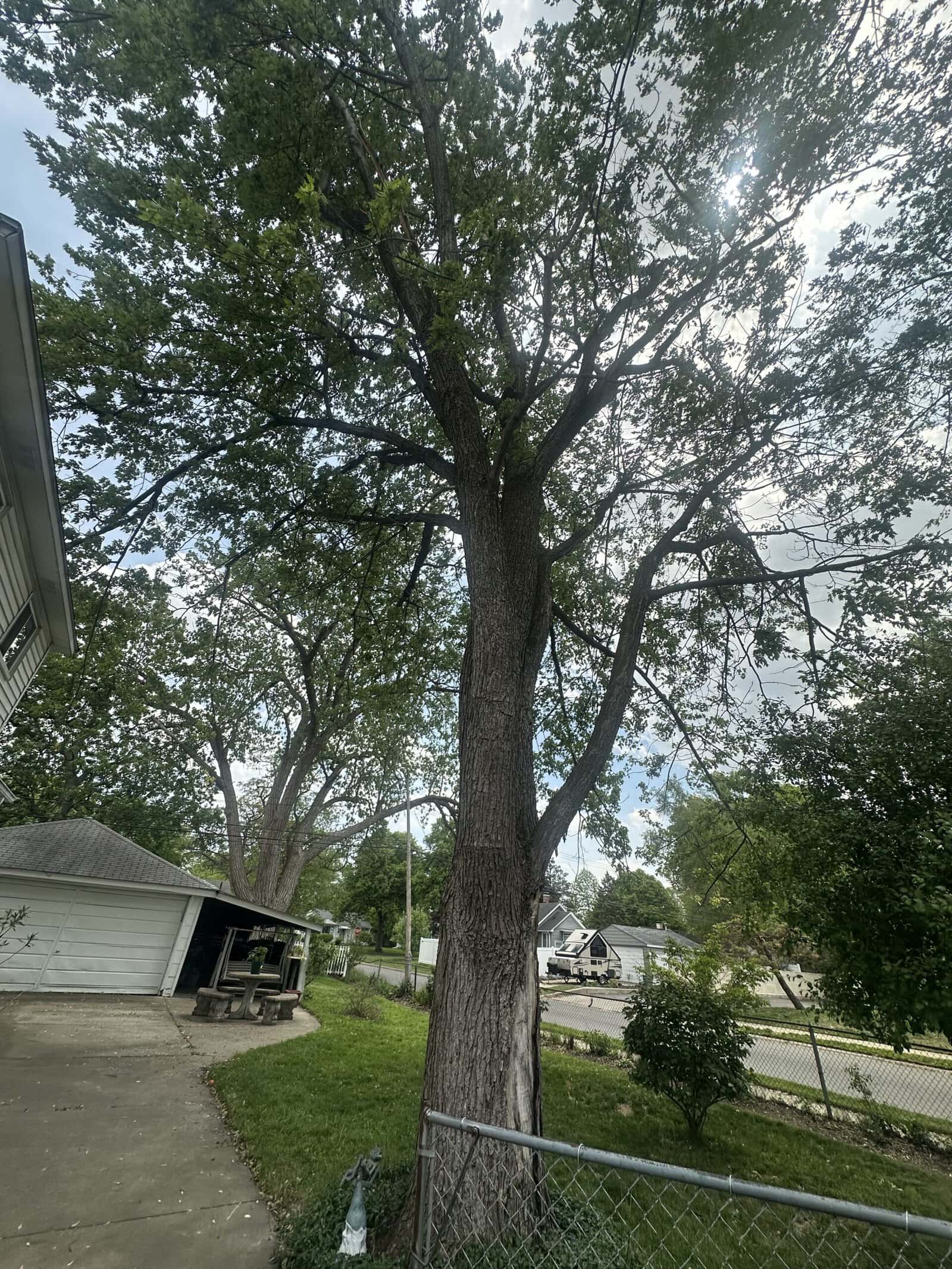
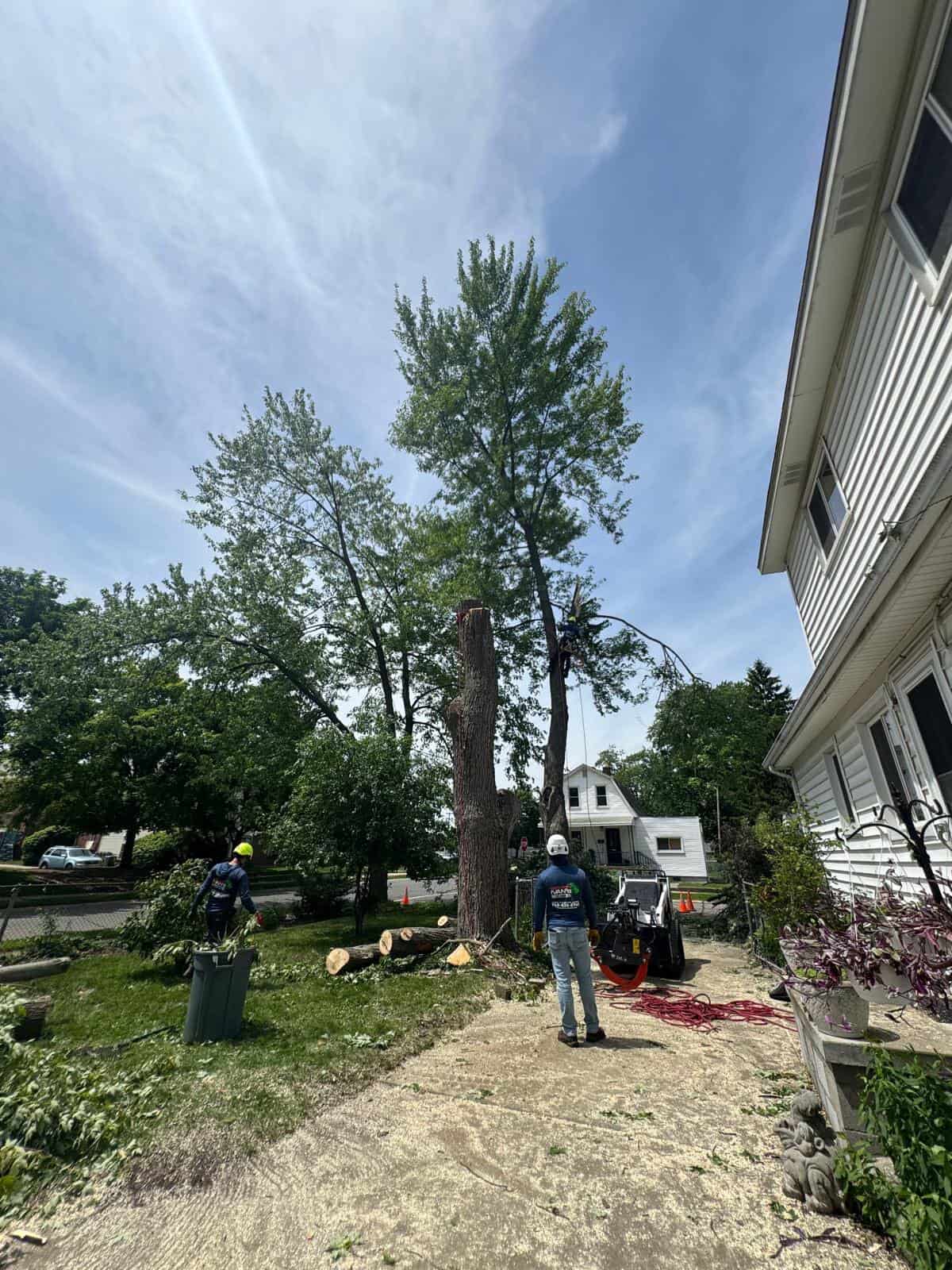
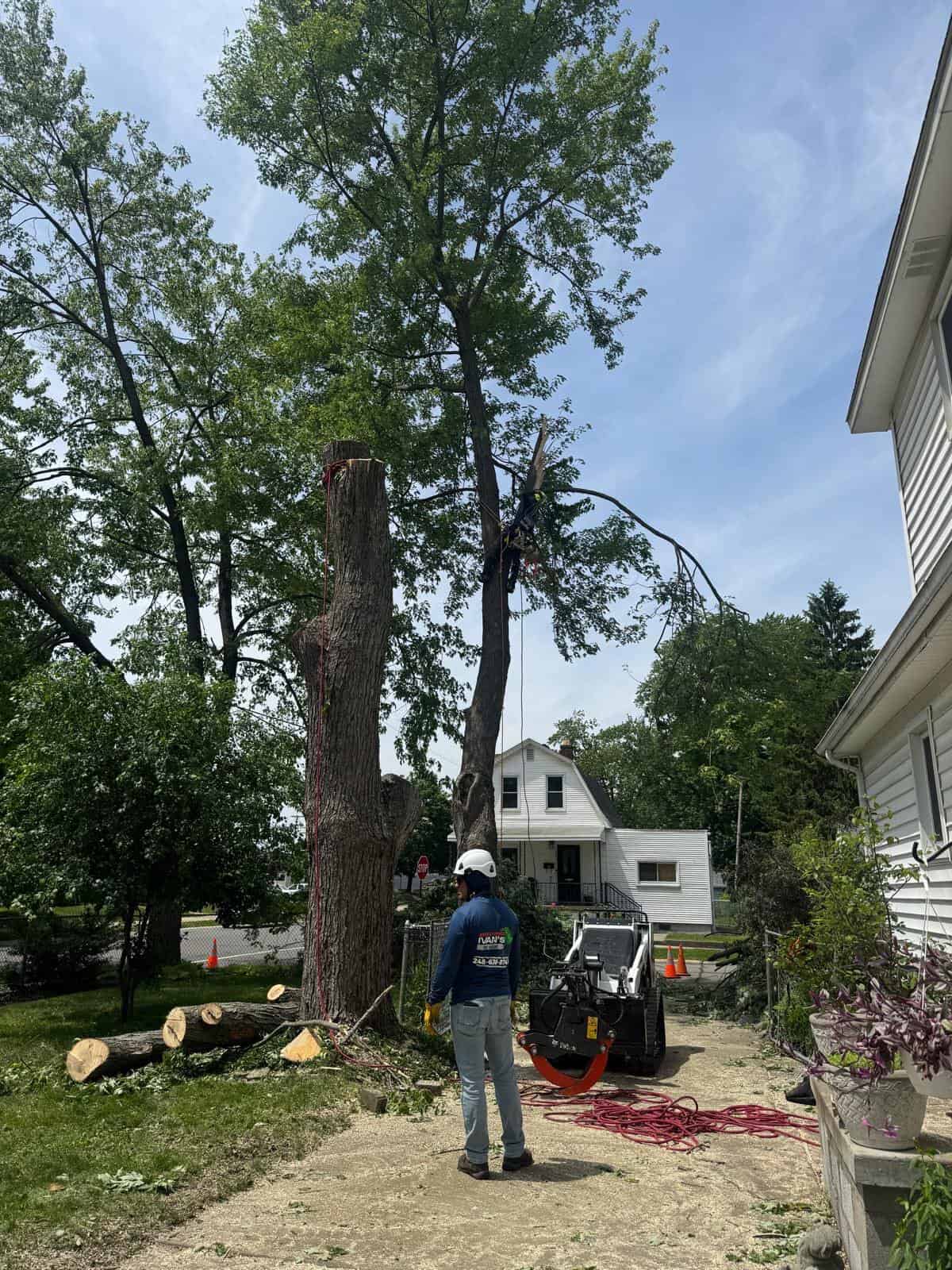
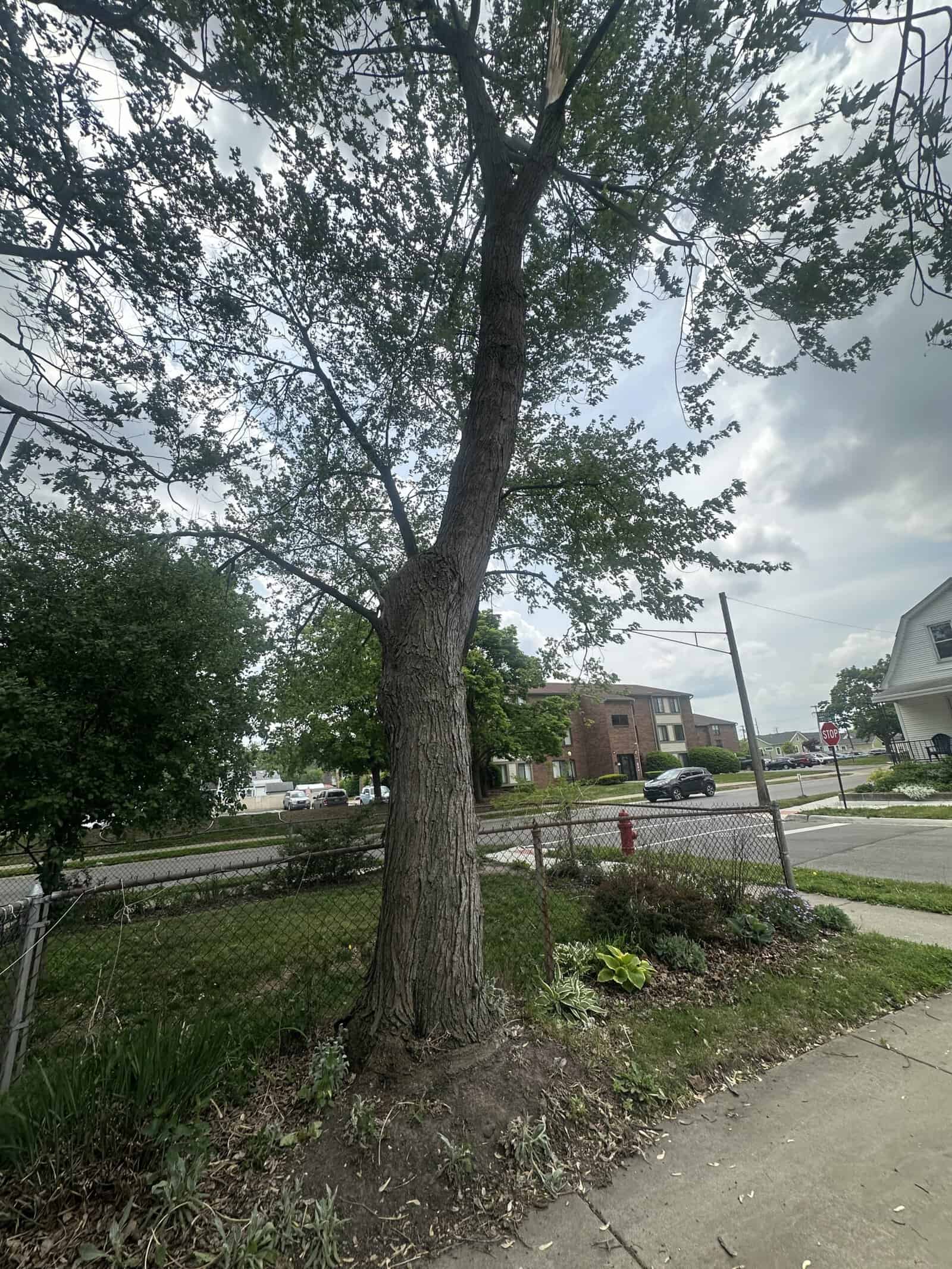
Tree removal in Ann Arbor covers a wide range of situations, and we handle all of them. Routine removal of dead, dying, or structurally compromised trees is the most common call — and in Washtenaw County, Emerald Ash Borer has left a significant number of ash trees in exactly that condition. EAB-killed ash trees deteriorate faster than most homeowners realize, becoming brittle and unpredictable well before they look obviously dangerous from the street. If you have an ash tree on your property that hasn’t been assessed, it’s worth a look.
Hazardous tree removal is a specific category that requires more than just cutting experience. When a tree is leaning toward a structure, showing signs of root heave, or has visible trunk damage after a storm, the removal process needs to account for the instability. Our TRAQ-qualified assessors evaluate the actual risk level before any work begins, which means the removal plan is built around the specific condition of that tree — not a one-size-fits-all approach.
We offer emergency tree removal 24 hours a day, seven days a week. After the April 2026 storm system that brought a confirmed EF1 tornado through Washtenaw County and uprooted trees across Ann Arbor, the demand for immediate response was real. That kind of availability is a practical necessity in a city that sees that level of storm activity every year. Stump grinding and full debris removal are also available as part of any job or as standalone services.
It depends on the tree. Ann Arbor has one of the more active tree ordinances in Michigan. Any work on a city-owned street tree — including removal, trimming, stump grinding, and even fertilization — requires a written permit under Chapter 40 of the city’s code. Doing that work without a permit is a violation of city ordinance, not just a procedural oversight.
For trees on private property in Ann Arbor, the rules are a bit different. Dead trees, hazardous trees, and invasive species can generally be removed without a permit. However, if the tree qualifies as a Landmark or Woodland tree, additional protections apply — and removal may require mitigation in the form of replacement plantings or a Canopy Loss Fee paid to the city.
If you’re not sure which category your tree falls into, that’s exactly the kind of question to sort out during the on-site assessment before any work begins. Getting it wrong after the fact is a much harder problem to fix.
This is one of the most common questions, and it’s a fair one — especially in Ann Arbor, where people genuinely care about the trees on their property. The honest answer is that it depends on what’s actually going on with the tree, and a visual check from the street doesn’t tell the whole story.
Some warning signs are obvious: a significant new lean after a storm, visible trunk cracks, exposed or heaving roots, or large sections of dead crown. Others aren’t visible at all — internal decay, root system damage, and structural weakness can exist in a tree that looks completely healthy from the outside.
A TRAQ-qualified risk assessment uses a formal methodology to evaluate the actual condition of the tree and the level of risk it poses. In some cases, trimming, cabling, or treatment is a legitimate alternative to removal. In others, removal is the only responsible option. The goal of the assessment is to give you an honest answer — not to push you toward the most expensive outcome.
First, stay away from the tree until you know what you’re dealing with. A storm-damaged tree can have structural damage that isn’t visible — split trunks hidden by bark, root systems that lifted and resettled, or hanging limbs that are under tension and can release without warning. What looks stable often isn’t.
If the tree is near your home, a fence, a vehicle, or overhead utility lines, treat it as a hazard until a professional has assessed it. In Ann Arbor, where spring and summer thunderstorms regularly produce the kind of wind events that bring trees down on homes and businesses — the July 2026 storms produced documented 60–70 mph gusts across Washtenaw County — this isn’t an overreaction. It’s the right call.
One more thing: if the tree has fallen onto a structure, contact your homeowners insurance company before removing it. Removal prior to an adjuster’s visit can affect your claim. We offer 24/7 emergency response, so the tree can be stabilized or removed quickly once you’ve made that call.
Yes, it’s more complicated — and not every tree service is equipped to handle it. Working near energized utility lines requires specific training that goes beyond general tree removal experience. In Ann Arbor’s older neighborhoods, particularly in areas like Burns Park, Old West Side, and Kerrytown, mature trees frequently grow into or directly adjacent to overhead distribution lines. That’s not a rare edge case here — it’s a common situation in the established residential areas of the city.
Our team is specifically trained and certified to work near electric poles. That means the crew knows how to approach those jobs safely, how to rig and control the removal to avoid contact with lines, and when to coordinate with the utility provider before work begins. Hiring a crew that isn’t trained for this type of work creates serious risk — to the crew, to the property, and to the homeowner who may be liable if something goes wrong.
If your tree is anywhere near utility infrastructure, make sure the company you hire has verified training for that type of work before they start.
Based on completed projects in the Ann Arbor area, tree removal costs in Washtenaw County typically range from around $566 to $768 on average, though the actual cost for any specific job depends on the size of the tree, its location on the property, proximity to structures or utility lines, and whether stump grinding is included.
Smaller trees — generally under 30 feet — tend to fall on the lower end of that range. Larger trees, trees near structures, or trees that require crane-assisted removal or specialized rigging will cost more. Emergency removal after a storm can also carry a premium depending on the timing and conditions.
What’s worth keeping in mind is that the cheapest quote isn’t always the most cost-effective option. A low number from an uninsured crew that doesn’t include cleanup, stump grinding, or debris hauling can end up costing more in the long run — both in out-of-pocket add-ons and in liability exposure if something goes wrong on your property. We provide written, transparent estimates so you know exactly what’s included before any work begins.
Yes — stump grinding is available as part of any removal job or as a standalone service. This is worth clarifying because a lot of homeowners assume the stump is automatically included in a tree removal quote, and it often isn’t. If you received a quote elsewhere and it seemed unusually low, stump removal may not be part of what was priced.
Stump grinding takes the stump down below grade — typically several inches below the surface — so the area can be replanted, sodded, or simply left without an obstacle in the yard. It’s a cleaner finish than leaving a stump in place, and in Ann Arbor where homeowners have invested significantly in their properties, it’s usually the preferred outcome.
For EAB-affected ash trees specifically, stump removal is often a good idea. The root systems of dead ash trees can continue to push up shoots for years after the tree is gone, and grinding the stump helps prevent that. If you’re not sure whether stump grinding makes sense for your situation, it’s an easy question to answer during the on-site walkthrough.
Other Services we provide in Ann Arbor
