
Not every tree that looks rough is actually dangerous, and not every tree that looks fine actually is. That gap is where most homeowners get it wrong: either paying to remove a tree that only needed a prune, or ignoring one that comes down on a car, a fence, or a roof during the next windstorm. Here’s how to tell which side of that line your tree is really on, and what to do next.
The Signs That Actually Matter
A tree doesn’t have to look dead to be hazardous. Some of the most dangerous trees on a property still have full green canopies. What actually predicts failure is structure, not appearance.
Cracks and splits in the trunk or major limbs
A vertical crack running into the trunk, especially one that opens and closes slightly when the wind blows, means the wood fibers holding that section together are already separating. This is one of the more reliable warning signs there is: a tree with a trunk crack of any real depth is a same-week call, not a wait-and-see situation.
Mushrooms or conks growing on the trunk or root flare
Fungal fruiting bodies (the mushroom-like shelves you sometimes see growing directly out of bark, or scattered in a ring around the base) are a visible sign of internal decay that’s often been progressing for years before it shows up on the outside. By the time you can see the fungus, the wood underneath has typically lost a meaningful percentage of its structural strength. Conks near the root flare are a particular concern because that’s exactly where a tree needs strength to stay upright.
A lean that’s new, or getting worse
Plenty of healthy trees have a natural lean and have had it for decades. That’s not automatically a problem. What matters is change. A lean that’s appeared recently, or one where you can see disturbed or lifted soil on the side opposite the lean, often means the root plate is failing, not just the trunk growing at an angle. Soil heaving like that is frequently the last visible warning before a tree goes over in a storm.
Dead limbs over two inches thick, especially near the house
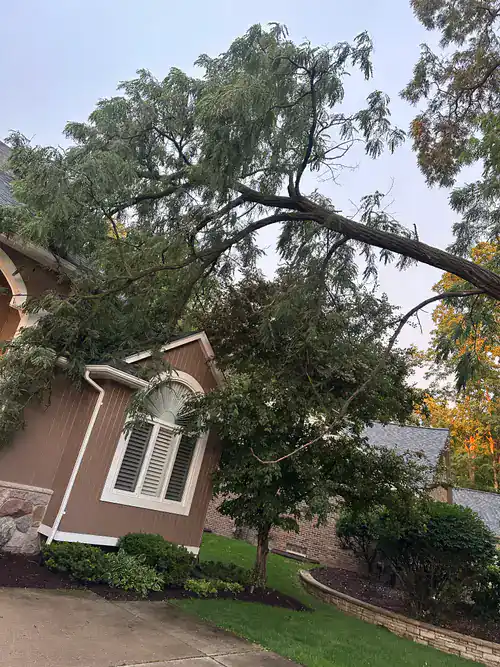
Small dead twigs are normal tree maintenance and rarely worth worrying about. A dead limb over two inches in diameter is a different story, particularly if it’s hanging over a roof, a driveway, a play area, or anywhere people or cars regularly sit still. Dead wood doesn’t bend in the wind the way live wood does. It just breaks, often with no warning at all.
Included bark where two major limbs meet
When two large branches grow from nearly the same point and the angle between them is tight, bark can get pinched into that union instead of solid wood forming. From the ground it can look like a completely normal branch union. Structurally, it’s one of the weaker points a tree can have, and it’s a common failure point in wind and heavy snow, which matters here, since Oakland County sees real snow load most winters.
What to Do If You Spot One of These
None of the signs above are a DIY diagnosis on their own: a tree can have one of these and still be perfectly stable for years, or have none of them visible and still fail. What they’re good for is deciding how fast to act:
- Trunk crack, visible lean change, or soil heaving: treat it as urgent. Keep people, cars, and pets away from the drop zone until it’s been looked at, and call the same day if you can, especially before a forecasted storm.
- Fungal growth on the trunk or root flare, or dead limbs over structures: don’t panic, but don’t let it sit for a season either. Get it assessed within the week.
- Everything else (general dead-looking branches, a longstanding lean, thinning canopy): worth a call, but it’s reasonable to schedule a normal appointment rather than treat it as an emergency.
When we assess a hazardous tree, we’re looking at the whole picture together: trunk condition, root flare, canopy density, lean, and what’s actually in the drop zone if the tree or a limb came down. A tree twenty feet from the nearest structure gets a different recommendation than the same tree six feet from a bedroom window, even if the tree itself looks identical.
We’re Set Up for This to Move Fast
We run 24/7 emergency response specifically because hazardous trees don’t wait for business hours: a trunk crack you notice Sunday morning shouldn’t have to wait until Monday for someone to look at it. If removal turns out to be the right call, that’s a service we handle start to finish, including full cleanup and stump work if you want it done at the same time.
If you’re not sure which category your tree falls into, that’s a completely normal reason to call. A quick look from someone who does this every day is a lot cheaper than guessing wrong in either direction, and free estimates mean there’s no cost to finding out.