
Tree Pruning in Greenbush, MI
Lakefront Trees Need More Than a Trim
Hear from Our Customers
Professional Tree Pruning, Alcona County
The Sunrise Side is beautifuland it’s also one of the most ice-storm-prone corridors in the state. The March 2025 storm alone toppled millions of trees across the stretch from Lake Michigan to Lake Huron, and the Huron Shores area took another hit in 2026. When your trees carry a full, unmanaged canopy going into that kind of weather, the weight of ice on those branches isn’t a small risk.
Crown thinning reduces that load. Structural pruning removes the weak limbs before they fail. The result is a tree that can actually handle what northern Michigan throws at it.
For the large portion of Greenbush properties that sit vacant most of the year, there’s a second problem that’s easy to overlook. Trees change while you’re gone. Dead limbs develop, canopies shift, and structural issues that were minor in October can be serious by the time you pull into the driveway in May. Getting your trees assessed and properly pruned means fewer unpleasant surprises at the start of the seasonand fewer emergency calls when something finally gives way over the roof or across the driveway.
Cleanup is part of every job. No brush piles left behind, no debris on the lawn or beach path. When we leave, the property should look like the work was done rightbecause it was.
Tree Trimming Services, Greenbush Michigan
We’re a family-owned operation out of MichiganIvan handles every job in the field, and Cecilia manages scheduling and communication on the back end. That means when you call, you reach a real person who knows the job, knows the property, and can actually answer your questions. There’s no call center, no runaround.
For Greenbush and Alcona County property ownersespecially those managing a cottage on Cedar Lake or a beachfront property along US-23 from a few hours awaythat kind of direct communication matters. You shouldn’t have to wonder whether the work got done or chase someone down for an update. Cecilia keeps that from being your problem.
We’ve been doing this work across Michigan for over seven years. General liability and workers’ compensation insurance are both in place, and every job comes with a 30-day workmanship guarantee. That’s not something you’ll find from most local operators in this area, and it’s not a small thing when you’re trusting someone to work on your property without you standing there watching.
How Tree Pruning Works in Greenbush
It starts with a call or a message. Cecilia will get you scheduled for an on-site assessmentIvan visits the property, walks the lot, and actually looks at the trees before anything else happens. He’s looking at branch structure, dead wood, canopy weight distribution, and any limbs that are positioned over structures or access points.
On lakefront and near-lakefront properties in Greenbush, that assessment also accounts for the wind exposure and shallow sandy soils that make proper crown management more important here than in a typical suburban yard.
After the walkthrough, you get a clear written estimate. The scope is explained, the price is stated, and there’s no pressure to commit on the spot. If you’re managing the property remotelywhich describes a lot of Greenbush cottage ownersthat written estimate can be reviewed and approved without you needing to be physically present.
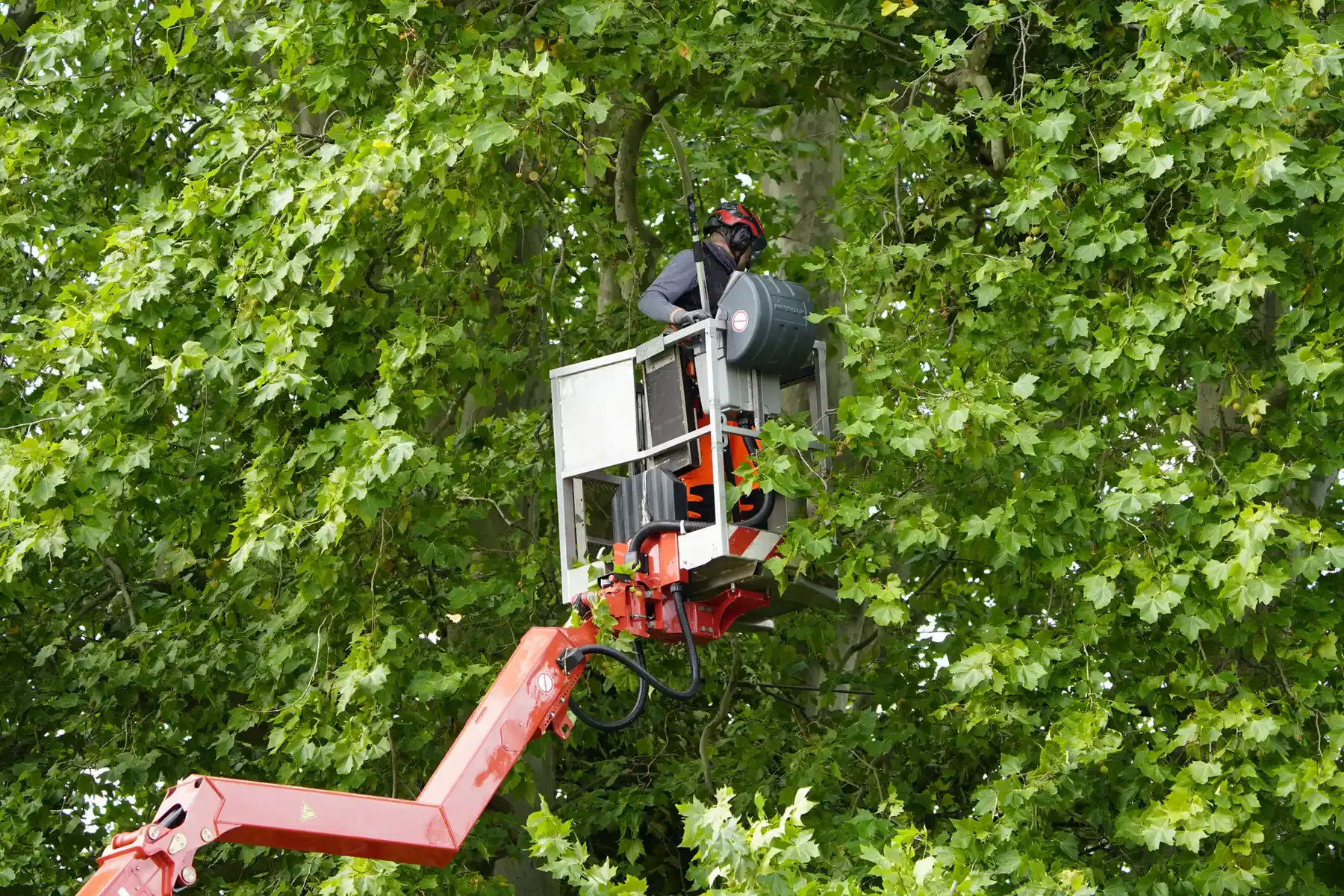
Once the work is scheduled and we arrive, the process follows proper pruning technique throughout: cuts are made at the branch collar to support natural healing, no more than 25% of the tree’s foliage is removed in a single session, and nothing gets topped. When the job is done, the property gets cleaned up completely. Branches, brush, and debris are cleared before we leave. The 30-day workmanship guarantee covers the quality of the work after the factso if something isn’t right when you get back to the cottage, it gets corrected.
Ready to get started?
Crown Reduction Pruning, Northern Michigan
Tree pruning isn’t one thing. Depending on what your trees need, the work might involve crown thinningselectively removing branches throughout the canopy to reduce density, improve air circulation, and cut down on the sail effect that makes trees vulnerable in high-wind events off Lake Huron. Or it might be crown reduction pruning, which brings the overall size of the canopy down in a way that maintains the tree’s natural shape while reducing the structural load.
Dead branch removal is often part of the same visitclearing out what’s already failed or failing before it drops on its own.
For the wooded lots common throughout Greenbush Township, many of which sit on second-growth forest that hasn’t been professionally managed in decades, the first pruning assessment often reveals more than the property owner expected. White pine, birch, and maple that have grown to full canopy height without any structural guidance tend to carry crossed branches, competing leaders, and significant dead wood accumulation. That’s not a crisisit’s just what unmanaged trees dobut it does mean the first visit typically involves more thorough work than ongoing maintenance would.
Greenbush is an unincorporated community, so there’s no municipal tree permit requirement for work on private property. On lots that border Huron National Forest land, the distinction between private and federal land matterslive trees on National Forest property cannot be cut without authorization, regardless of where your property line sits. We work on private property only, and that boundary is always respected.
When is the best time to prune trees on my Greenbush lakefront property?
For most deciduous treesmaple, birch, oakthe ideal pruning window is during dormancy, roughly November through March. The tree is under less stress, wounds seal more efficiently before spring growth kicks in, and without foliage in the way, the branch structure is easier to assess accurately.
That said, most Greenbush seasonal property owners aren’t on-site during the winter months, which creates a practical gap between the technically optimal time and when the work actually gets scheduled. The good news is that spring and early summer pruningwhen owners are returning to their properties along US-23 and Cedar Lakeis still effective for most species.
One exception worth knowing: oak trees in Michigan should be pruned before April if possible, or after July, to avoid the active sap flow window when oak wilt transmission risk is highest. If you’re dealing with an oak on your property and it’s late spring, it’s worth a quick call to discuss timing before scheduling the work.
What's the difference between tree trimming and tree pruning, and which do I need?
Trimming is primarily about appearanceshaping a tree so it looks neat, clearing branches that are growing in an unwanted direction, or maintaining a particular form. Pruning goes deeper. It’s about the health and structural integrity of the tree: removing dead, diseased, or structurally weak branches that threaten the tree’s long-term survival or the safety of the property around it.
In practice, most jobs involve both. A tree that needs its canopy thinned for wind resistancewhich is a real consideration for properties along the Lake Huron shorelinealso benefits from having dead wood and crossing branches removed at the same time. When Ivan assesses a tree, he’s looking at the full picture: what it needs structurally, what poses a risk, and what will keep it healthy for the long term. The goal isn’t just a tree that looks better after the visitit’s a tree that’s genuinely in better condition.
How do I know if a tree on my Greenbush property actually needs pruning?
A few things are easy to spot from the ground: dead branches that have lost their bark or are visibly dry and brittle, limbs that are hanging at an unusual angle, or a canopy that has grown so dense it’s blocking light to the point where nothing grows underneath it. Any branch positioned over a roof, a deck, or a driveway deserves a closer look regardless of whether it appears dead or alivea structurally compromised live branch can fail just as suddenly as a dead one.
For Greenbush properties that sit vacant through the winter, the spring arrival is often when these issues become visible. Ice accumulation during a northern Michigan winter adds significant weight to canopy branches, and the damage doesn’t always look dramatic from the outside. A limb that survived the season may have developed a crack or a split that isn’t obvious until you’re standing under it.
If you’re returning to a property after a winter that included ice eventsand recent winters in the Huron Shores area have been rougha professional assessment before assuming everything is fine is worth the time.
Is it safe to prune large trees near my cottage without a professional?
For anything beyond ground-level work with hand tools, the honest answer is noand not because the work is technically complicated, but because the physical risk is real. Falls from ladders are among the leading causes of serious injury for homeowners attempting tree work. Add a chainsaw, an overhead branch under tension, and the unpredictability of how a limb actually falls, and the margin for error gets very small very quickly.
Beyond the safety issue, improper cuts cause permanent damage. A flush cutmade too close to the trunkremoves the branch collar that the tree uses to seal the wound. A stub cutleaving too much behindcreates a dead entry point for decay. Either mistake can compromise a tree that was otherwise healthy.
On properties with mature, second-growth trees like those common throughout Greenbush Township, that kind of damage to a 60- or 80-year-old tree isn’t easily undone. The cost of professional pruning is a fraction of what it costs to remove a tree that was damaged by improper DIY work.
What does proper tree pruning actually do to protect against storm damage?
The core mechanism is straightforward: a dense, unpruned canopy acts like a sail. Wind pushes against the surface area of the foliage and branches, and that force transfers down to the trunk and root system. In shallow, sandy soilswhich are common on lakefront and near-lakefront properties in Greenbushthe root anchorage is already less deep than in inland clay or loam soils.
That combination of high wind load and limited root depth is exactly the scenario that leads to uprooting and catastrophic limb failure. Crown thinning reduces the canopy’s surface area without removing the tree’s overall shape or height. It lets wind pass through rather than push against the tree.
Structural pruning removes the specific limbsthe ones with tight V-shaped crotches, the ones already showing signs of decay, the ones growing at angles that put them under chronic stressthat are most likely to fail when conditions get severe. The March 2025 ice storm that devastated the Lake Huron corridor was a reminder that this isn’t a theoretical concern in Greenbush. Trees that had been properly maintained fared significantly better than those that hadn’t.
Does Ivan's Tree Services work with out-of-area owners managing a Greenbush vacation property?
Yes, and a meaningful portion of the work in communities like Greenbush involves exactly that situation. Roughly half of all homes in the Greenbush area are seasonal or vacation properties, and the owners are often in metro Detroit, Lansing, or elsewhere in Michigan for most of the year.
Managing a property from a distance means you need a contractor who communicates clearly, follows through without being supervised, and gives you documentation of what was agreed to and what was done. The process at Ivan’s Tree Services is set up for this. Ivan visits the property and conducts the assessment in person. Cecilia handles the communication and scheduling side, so there’s always a real person to reach.
The written estimate is provided before any work beginsyou can review and approve it without needing to be on-site. And the 30-day workmanship guarantee means that if something isn’t right when you return to the property, it gets addressed. For out-of-area owners who can’t stand over the job while it’s happening, that combination of written documentation and a post-completion guarantee provides a level of accountability that a handshake deal with a local operator typically doesn’t.
Other Services we provide in Greenbush